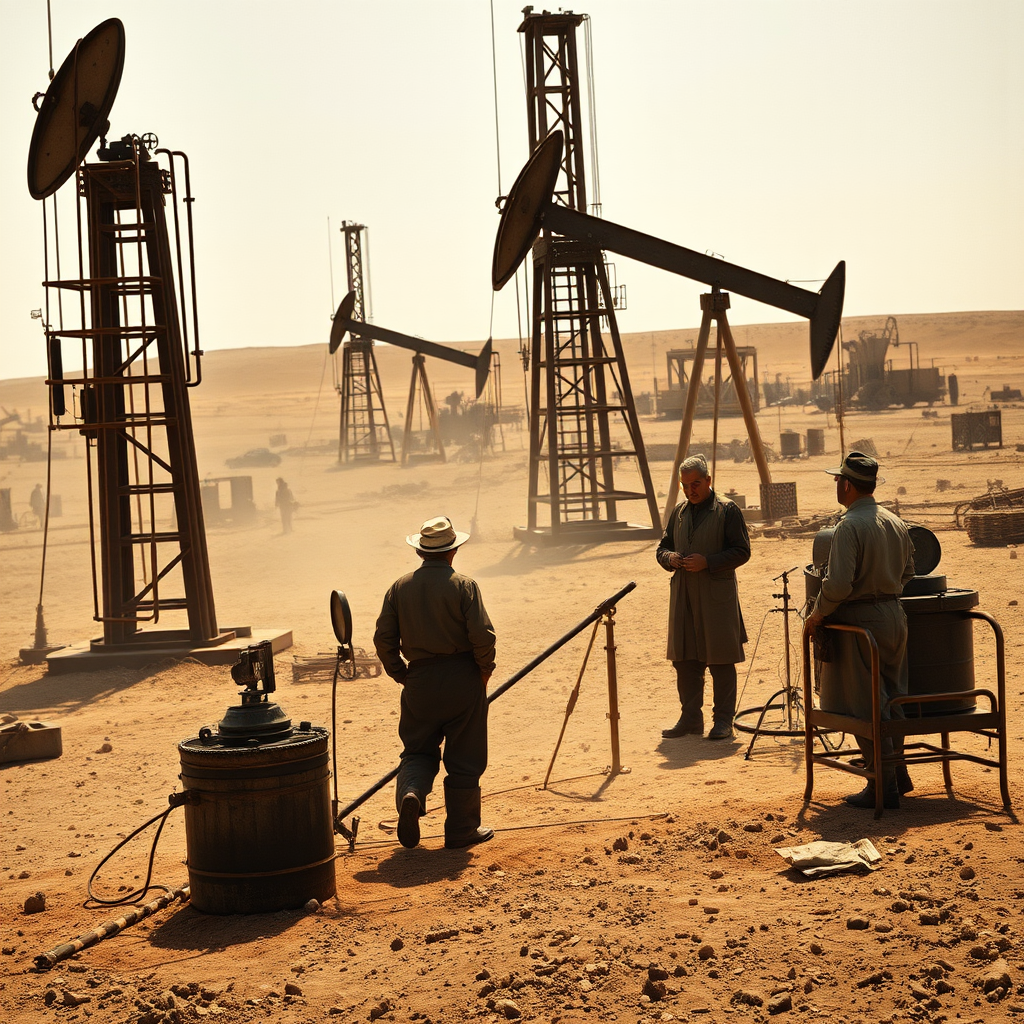

The first person to discover oil in Iran was a man from Brighton.
George Bernard Reynolds, a “stubborn” English geologist, struck one of the most consequential wells in modern history on May 26, 1908 — a discovery that would reshape the Middle East, fuel the British Empire, and set in motion a chain of events still reverberating today as the United States and Iran edge towards conflict over the region’s oil.
An unlikely hero from Sussex
According to a recent article in The Times , Reynolds was born the son of an admiral and cut an unmistakable figure: a “caricature” of a British Empire-builder with elaborate Edwardian facial hair, granite self-confidence and a stubborn contempt for bureaucratic interference.
A contemporary described him as “physically tough, mentally alert, a loner, contemptuous of ‘office wallahs’ but generous to those who shared with him the discomforts of the scorching sun, the freezing nights and the barren landscape.”
An image from Reynolds’ 1908 discovery (Image: Wikimedia)
Before his Iranian adventure, Reynolds had cut his teeth on the Indian railways and in the Dutch oilfields of Sumatra. He was 48 years old when William Knox D’Arcy — a flamboyant British mining entrepreneur and horse-racing enthusiast who had secured an oil concession over three-quarters of Iran in 1901 — brought him in to run field operations in Persia.
You can read The Times article about Reynold here: Stubborn Briton at root of Iran’s oil story
Seven years of failure — and one refusal to quit
Reynolds spent seven gruelling years in the desolate deserts of southwestern Iran without finding a single drop of usable oil. He faced bandits, scorpions, sunstroke, exotic diseases and freezing desert nights. He led a remarkably international team of local labourers, Polish and Canadian drillers, an Indian doctor and an American engineer from the Texas oilfields, The Times notes.
By May 1908, D’Arcy — who had by then spent £200,000 on the project and was facing bankruptcy — sent a telegram ordering Reynolds to stop. “Cease work,” it read. “Dismiss the staff, dismantle anything worth the cost of transporting to the coast for reshipment and come home.”
In a consequential twist of fate, Reynolds ignored it.
A photo from Reynolds’ 1908 discovery of oil in Iran (Image: National Iranian Oil Company)
He had been tipped off about the site — known as Meidan Naftoon, meaning “field of oil” — by Sir Louis Dane, a colonial administrator he had met in Kuwait. Drilling had started in January 1908 at the location of an ancient Zoroastrian fire temple in Khuzestan province, and Reynolds could already detect the sulphurous smell of gas rising from the hole. He believed he was close.
The gusher that changed history
On May 26, 1908, Reynolds struck a “gusher” at a depth of 1,180ft — oil spouting 80ft into the sky from an enormous reservoir holding an estimated 65 billion barrels of black gold. It was the first commercial oil discovery in the Middle East.
The news was relayed to D’Arcy via a camel courier to Baghdad and then by telegraph, in a prearranged code designed to confuse rival French prospectors.
You can see footage of Reynolds in Iran below.
A legacy carved in conflict
The Anglo-Persian Oil Company — later renamed British Petroleum, which became BP — was born from that discovery, laying a 140-mile pipeline to the Gulf and making cheap Iranian oil a cornerstone of British imperial policy.
In June 1914, just two months before the outbreak of the First World War, First Lord of the Admiralty Winston Churchill pushed through legislation granting the British government a 51 per cent stake in the company. Under the original D’Arcy concession, Iran continued to earn just 16 per cent of profits until the 1950s.
Oil has played a key role in the history of Iran and the Middle East since Reynold’s discovery (Image: PA)
Decision made on plans to remove indoor pool from flat owned by famous actress
Decision made on plans to remove indoor pool from flat owned by famous actress
Work to replace steps at popular beauty spot hit by cliff collapse ‘progressing well’
Work to replace steps at popular beauty spot hit by cliff collapse ‘progressing well’
Two people escape from flat above after fire breaks out at barber shop below
Two people escape from flat above after fire breaks out at barber shop below
Today, Iran produces around five per cent of the world’s oil, and the struggle for control of the Strait of Hormuz — through which one fifth of all seaborne oil trade passes — is once again at the centre of tensions between Tehran and Washington.
Despite his seismic discovery, Reynolds was “fired politely” in 1911 by the new management of the Anglo-Persian Oil Company. Undaunted, he then became the first person to strike oil in Venezuela in 1922, shaping that country’s history too. He died three years later in the Hotel Inglaterra in Seville.
As The Times puts it, Reynolds was “a lone Englishman, an eccentric and bloody-minded geological adventurer from Sussex who refused to stop drilling.