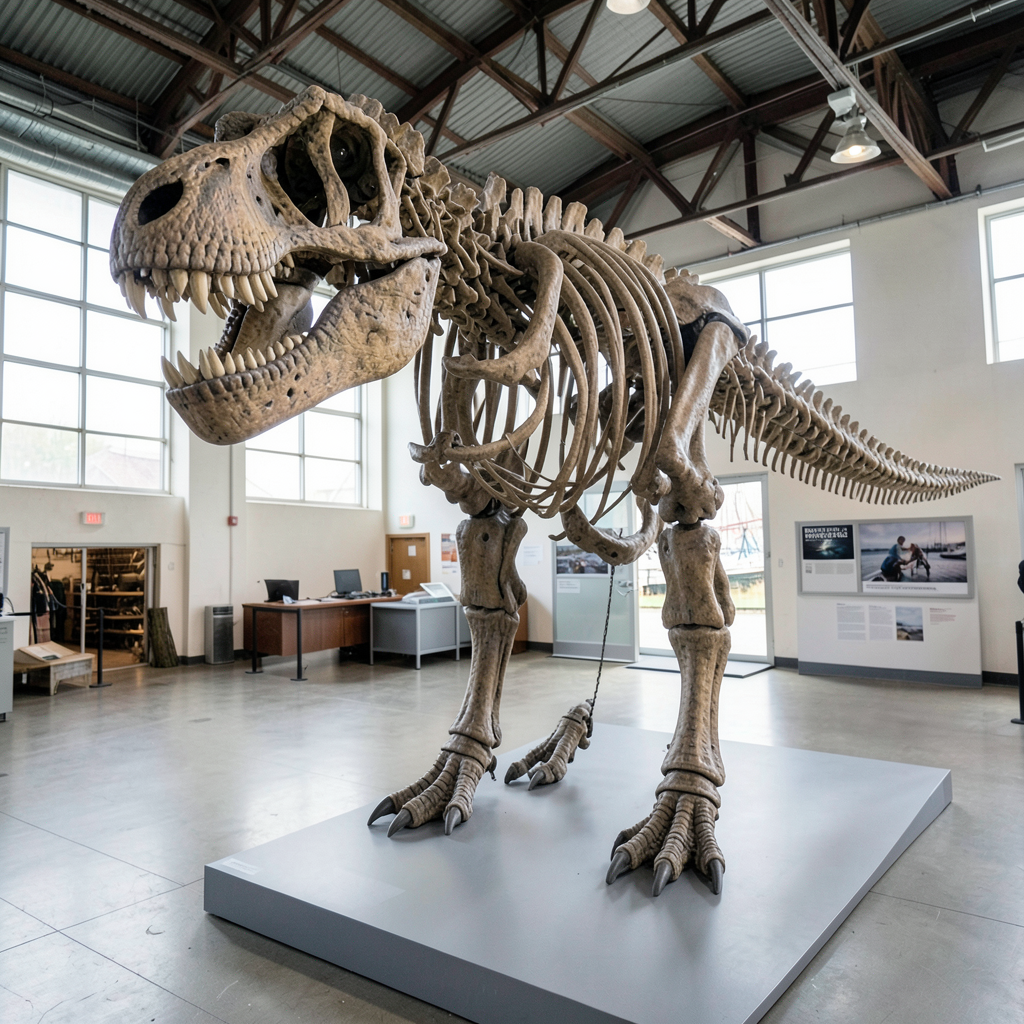

A Tyrannosaurus rex skeleton called Trinity is due to become the first of its kind to be exhibited publicly in the United Kingdom, with its Portsmouth unveiling planned for February.
The 67-million-year-old fossil will be presented at the city’s historic dockyard.
Trinity comprises 293 fossil bones originating from three distinct Tyrannosaurus rex specimens.
Each was found in the United States, with the discoveries made between 1995 and 2013.
The assembled skeleton measures 11.6 metres in length and stands 4.57 metres tall.
It will be housed in the Grade II-listed Boathouse 5 at Portsmouth Historic Dockyard.
Hannah Prowse, chief executive of Portsmouth Historic Quarter, said the collection contains genuine Tyrannosaurus rex fossils.
Visitors will be able to appreciate the scale of the remains while learning about the scientific questions that continue to surround them, she added.
Prowse described the decision to bring Trinity to Britain as a major privilege and said the exhibition is intended to promote authenticity, discovery and public access to significant fossils that might otherwise enter private collections.
The skeleton was auctioned in 2023 for more than $6 million, equivalent to around £4.5 million.
Its buyer was The Phoebus Foundation, an Antwerp organisation operating as a public-benefit art foundation in Belgium.
The University of Portsmouth is coordinating the exhibition and will provide educational programmes alongside supporting further academic research involving the skeleton.
The university is also seeking to involve local schools and is arranging public talks and other events featuring experts.
Dr Nizar Ibrahim, scientific director of the Dinosaur Museum Bavaria, has supervised the exhibition.
He said that despite Tyrannosaurus rex being among the most widely recognised dinosaurs, substantial gaps remain in scientific knowledge about these animals.
According to Ibrahim, Trinity offers opportunities to examine evidence relating to growth, locomotion, injuries, illness and survival.
He added that the remains can help researchers develop a fuller understanding of the lives of Tyrannosaurus rex individuals and move beyond the widespread portrayal of the species solely as a giant predator.
The fossil bones provide the starting point for that research, Ibrahim said, and can reveal what happened to the animals during their lives 67 million years ago, in the age of the dinosaur.
The exhibition is scheduled to open to the public on February 12, 2027.