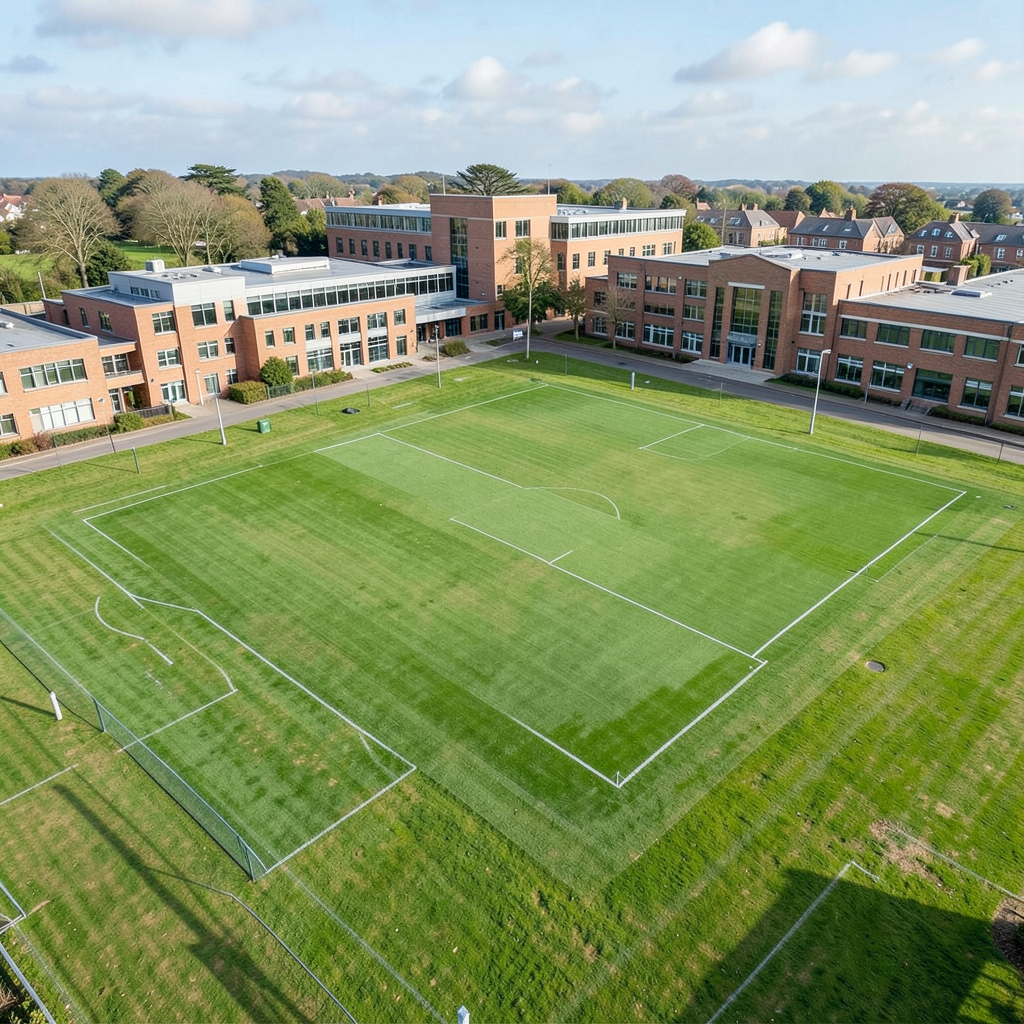

Brighton and Hove City Council’s planning committee has approved proposals for an artificial surface and multi-use games area at a local college, despite receiving more than a thousand protest submissions from members of the public.
The development would see two pitches constructed on the eastern section of the playing fields nearest to the college buildings at Bhasvic, with the nearest point situated just over 50 yards from the Brighton Open Air Theatre.
A vote was held on Wednesday, September 2, with eight committee members supporting the scheme and two opposing it, following presentations from both advocates and critics of the plans.
Graeme Hawkins, a trustee representing the theatre, urged councillors to limit use of the facility during spring and summer vacation periods, expressing concern that the pitches could operate beyond term time and interfere with theatrical productions.
Committee documentation indicated that, when measured against this year’s schedule, seven performances would have overlapped with the proposed operational hours of the sports pitches.
According to Hawkins, those seven affected performances could impact audiences totalling more than 2,000 people, with seven separate theatre companies potentially involved, many of which might choose not to return in subsequent years.
He suggested this scenario could pose a significant threat to the theatre’s long-term viability.
Steve Geliot, who serves as vice-chairman for the Friends of Dyke Road Park group, raised concerns about the impact on starlings, which would lose an important food source, as well as broader ecological consequences from artificial lighting affecting local wildlife populations.
Green Party member Nadia Barton Ahmed, representing Goldsmid ward and also leading the Friends of Dyke Road Park group, opposed the scheme.
She had previously studied at the college and noted that physical education is not currently available to the entire student body, suggesting the proposed development would primarily serve specialist sporting groups rather than the general population.
She argued that the green space provides valuable recreational benefits for all students at an institution facing accommodation constraints.
Her ward colleague, Labour representative Trevor Muten, also spoke in opposition, citing resident concerns that noise from the artificial surface, encompassing referee signals, voices and ball impacts, could disrupt performances and endanger the theatre’s financial sustainability.
Approximately 79 submissions in support of the application highlighted the demand for enhanced sporting facilities and noted that the Open Air Theatre already operates adjacent to existing sports grounds.
Independent councillor Samer Bagaeen, who represents Hove Park ward, addressed the committee in favour of the scheme.
He characterised the proposals as investment in youth sporting infrastructure on an established educational site, distinguishing this from residential or commercial projects that would replace public open space.
Molly McLean, representing the college as an agent from planning consultancy Whaleback, explained that Brighton and Hove has aspirations to establish itself as a hub for women’s sport and that the scheme would advantage the college’s own teams.
She clarified that the application did not constitute a change of use, since the location is already an operational playing field with football pitches currently utilised by students and community groups.
She stated that this arrangement had persisted throughout the college’s history without generating disputes with neighbouring properties.
College principal William Baldwin informed the committee that he wished to avoid generating antagonism between the institution and the wider city.
He expressed willingness to convene with representatives from the Open Air Theatre, review their performance schedule and negotiate an acceptable resolution.
Baldwin pointed out that no complaints had ever been raised regarding noise from the playing field, which accommodates a summer football programme during school holiday periods.
He argued against imposing a blanket prohibition on sporting activity during spring and summer breaks.
Following the decision, Baldwin expressed satisfaction with the committee’s endorsement.
He emphasised that maintaining positive relations with neighbours had consistently been the college’s objective and that efforts would continue to ensure both the theatre and the college could coexist productively while also addressing the urgent need for improved student facilities.
Independent councillor Bridget Fishleigh demonstrated potential environmental concerns by presenting rubber crumb particles recovered from her son’s football footwear.
She had voted against the application and was advised that no national regulatory framework exists specifically addressing rubber crumb infill.
She was further informed that alternative materials such as corn husk and cork would deteriorate more rapidly, creating safety risks and increasing costs.
Green councillor Sue Shanks attempted to introduce a condition preventing use of the pitches and multi-use games area during late spring half-term and summer vacation periods.
Planning officers indicated that conditions attached to permissions must be essential, enforceable and reasonable.
She ultimately voted against the scheme.
An existing condition requires a noise validation assessment to be conducted within the first two months of the facility becoming operational.
Labour member Paul Nann announced his support for the application, expressing confidence that two respected institutions with strong community standing could reach an accommodation that prevented mutual harm.
Conservative representative Carol Theobald stated her backing for sporting provision, describing it as beneficial for young people and expressing hope that the college could collaborate effectively with the theatre if approval was granted.
Green councillor Kerry Pickett maintained reservations about the failure to incorporate more environmentally sustainable surface materials and continued concern regarding microplastic contamination.
She noted that the site falls within a nature improvement area where the addition of microplastics remained problematic.