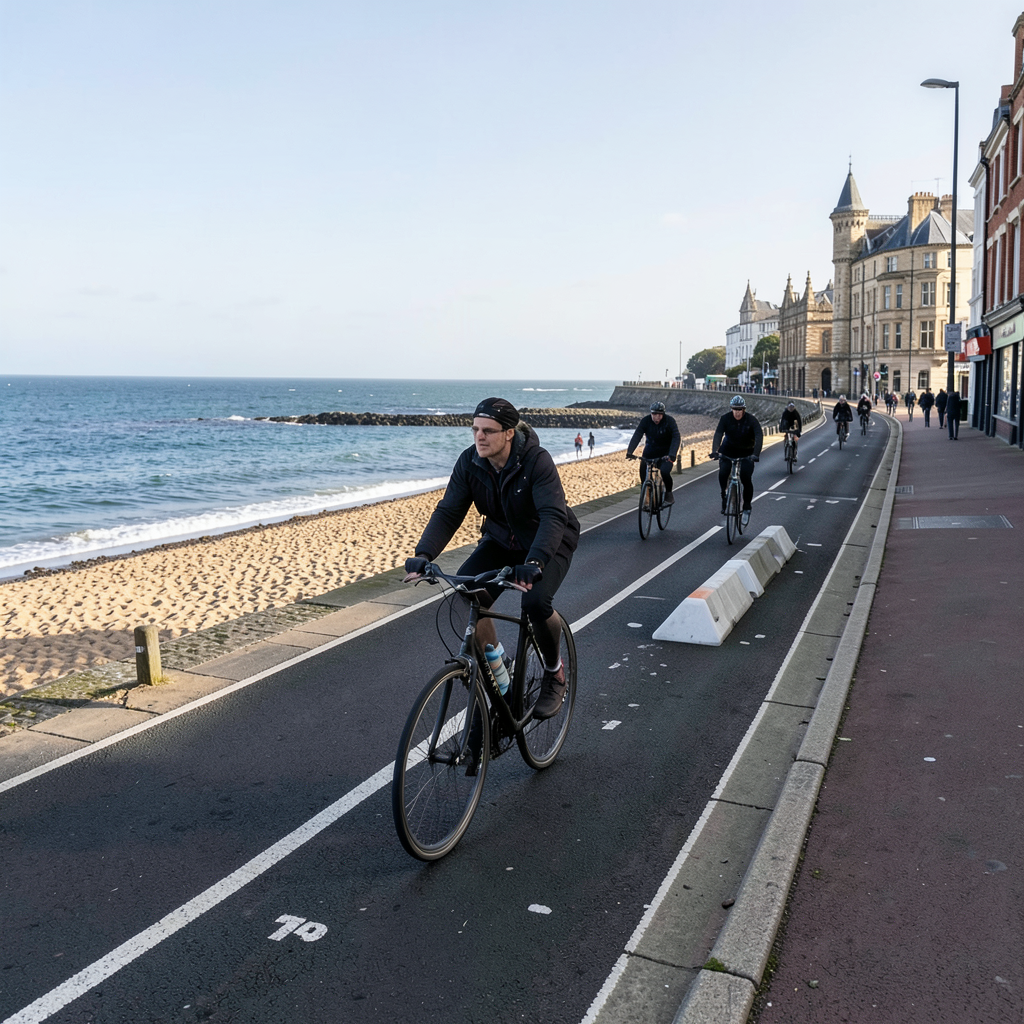

Brighton and Hove City Council has unveiled plans for significant enhancements to the seafront cycling infrastructure along the A259 corridor.
A six-week public consultation period has been initiated regarding the next stage of the A259 Active Travel Scheme, which seeks to provide improved travel options along the coastal area.
The proposed development would extend cycling provisions between Fourth Avenue and West Street, building upon works currently being planned for the western section of the coastline.
Under the existing arrangement, cyclists traveling westward are separated from vehicle traffic through the use of plastic delineators, while those heading east travel alongside the pavement.
This configuration would be entirely replaced by the new proposals.
The scheme instead envisions a two-way cycling path completely segregated from both motor vehicles and pedestrians, intended to make more effective use of the available space.
The route passes through several notable locations, including Hove Lawns, the Bandstand, Shelter Hall, the i360 observation tower, and the Brighton Centre.
Enhancements at these points would encompass resurfaced footpaths, realigned pedestrian crossings and junction layouts, new areas designated for loading and disabled parking, and more efficient arrangement of the road space.
Councillor Trevor Muten, who serves as cabinet member for transport and city infrastructure, stated that the A259 Active Travel Scheme represents one of the most substantial transportation improvement initiatives currently under development in the city.
The latest proposals further the council’s objective of establishing a safer, more accessible and environmentally sustainable seafront for all users.
The forthcoming section would complement the scheme already being progressed between Fourth Avenue and the city’s western boundary, contributing to the establishment of a continuous, high-quality route for pedestrians, wheelchair users and cyclists traversing the coastline.
As well as enhancing cycling provisions, the plans incorporate safer crossing points, improved footpath conditions and modifications to parking and delivery arrangements, designed to ensure the space serves all users more effectively.
The consultation addresses phase three, spanning from Fourth Avenue to the Peace Statue, alongside phase four, running from the Peace Statue to West Street.
Financial support for the initiative comprises £780,000 allocated by Active Travel England, supplemented by approximately £4 million in funding from the Department for Transport distributed across a four-year period.
Councillor Muten expressed support for widespread community participation in the consultation process, indicating confidence that providing high-quality infrastructure would render active forms of travel more appealing to a greater number of residents.
The current arrangement of cycling lanes was described as problematic, with acknowledgment that significant improvements are achievable.
The objective is to gather perspectives from the widest possible range of individuals.
Residents have the opportunity to submit observations on either individual phase, both phases collectively, or the scheme as a whole.
Full consultation documentation and detailed schematic drawings have been published via the council’s dedicated consultation portal.