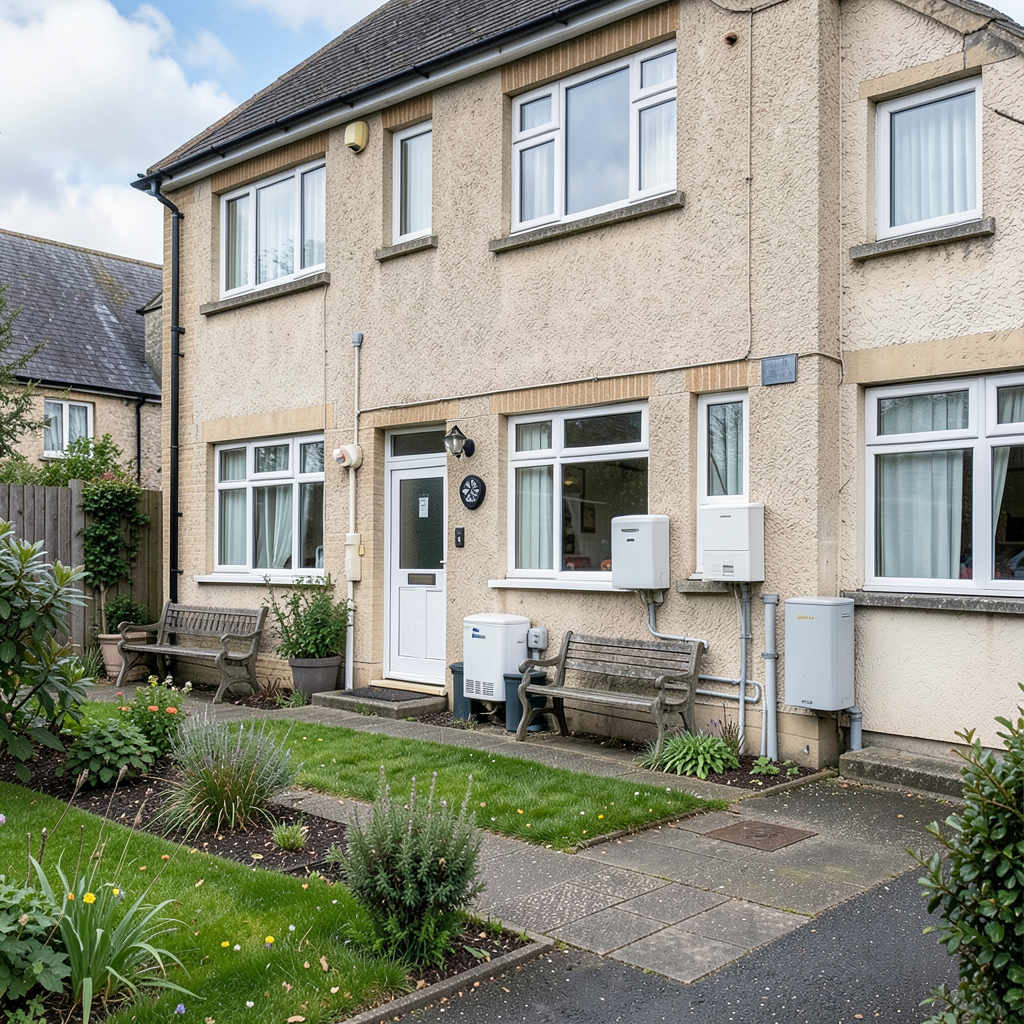

Surging energy expenses are placing residential care facilities under severe financial strain.
Providers operating throughout Sussex are finding it increasingly difficult to manage the fundamental, continuous requirements of heating, lighting and hot water without the safety net of a price ceiling or government assistance.
Care homes obtain their energy supplies through commercial agreements rather than domestic tariffs, which means they fall outside the scope of the household price cap and remain vulnerable to fluctuations in wholesale markets.
Manan Shah, co-founder of solar energy enterprise Solar4Good, explained that the energy challenge facing care homes extends well beyond spreadsheet calculations.
Operators find that energy expenditure directly influences decisions that closely impact the wellbeing of residents.
A facility must continue heating rooms, running kitchens, washing laundry and supporting care activities regardless of whether the escalating costs become difficult to manage.
The situation proves especially challenging in East Sussex, where more than a quarter of the local population has reached retirement age, compared with a national average of 18 percent.
Projections indicate that approaching one in three residents will fall into this age bracket by 2029.
Brighton and Hove similarly encounters substantial care requirements, with nearly one fifth of residents defined as disabled and approximately 18.7 percent of those aged 60 and above experiencing income deprivation.
Research from 2023 presents a concerning outlook for the sector.
A study conducted by Care England and Hft revealed that one third of adult social care providers operating in England had contemplated leaving the market during the preceding 12 months, while utility expenses climbed by as much as 500 percent for certain organisations.
The same research found that 82 percent of providers were either operating at a financial loss or experiencing reductions to their operating surplus.
Shah pointed out that for a typical 50-bed facility, even the per-resident cost figure represents a significant operational burden.
Unlike a standard household, a care home cannot simply switch off appliances or reduce services to manage expenses.
Heating, food preparation, laundry and illumination form integral components of the care environment rather than discretionary features.
According to estimates from Care England, typical yearly energy expenditure now reaches £1,233 per resident, with costs climbing to £1,757 in some facilities depending on geographic location, building condition and consumption patterns.
For a residential home accommodating 50 occupants, this translates to annual expenditure exceeding £61,000.
Shah noted that care homes cannot operate like commercial offices that might dim lighting over a bank holiday weekend.
A care facility maintains the same operational intensity on Christmas Day as it does during June.
This continuous demand makes the absence of price protection particularly hard to defend.
The Energy Bill Relief Scheme delivered temporary assistance to non-domestic energy consumers between October 2022 and March 2023.
The subsequent Energy Bills Discount Scheme concluded its support in March 2024, leaving care homes entirely exposed to commercial energy rates once more.
Shah observed that the previous support measures were conceived as emergency provisions and subsequently withdrawn as though the crisis had resolved.
However, care homes continue to face uninterrupted energy requirements, narrow profit margins and no equivalent of the domestic price cap.
The pressure has not evaporated; it has merely receded from prominent media attention.
The physical structures themselves can compound the difficulty.
Older buildings or those converted from previous uses frequently demand greater energy inputs to sustain safe temperatures, while their architectural layout may restrict possibilities for energy efficiency improvements.
Where circumstances permit, photovoltaic panels can enable care homes to offset a portion of their energy requirements.
Facilities constructed or renovated to meet net-zero specifications have the capacity to produce between 15 and 75 percent of their own electricity.
Shah explained that although the 15 to 75 percent range might appear considerable, the actual output depends on the level of solar installation the operator selects.
Solar therefore does not represent a complete solution and cannot substitute for appropriate policy measures safeguarding the sector.
Nevertheless, it constitutes one of the few practical actions available to care home operators in the present day.
Information pertaining to Brighton and Hove is sourced from the city council’s 2021 Census briefing and 2025 equality baseline documentation.
Figures concerning East Sussex derive from the county council’s demographic evaluation and the State of the County 2025 publication.