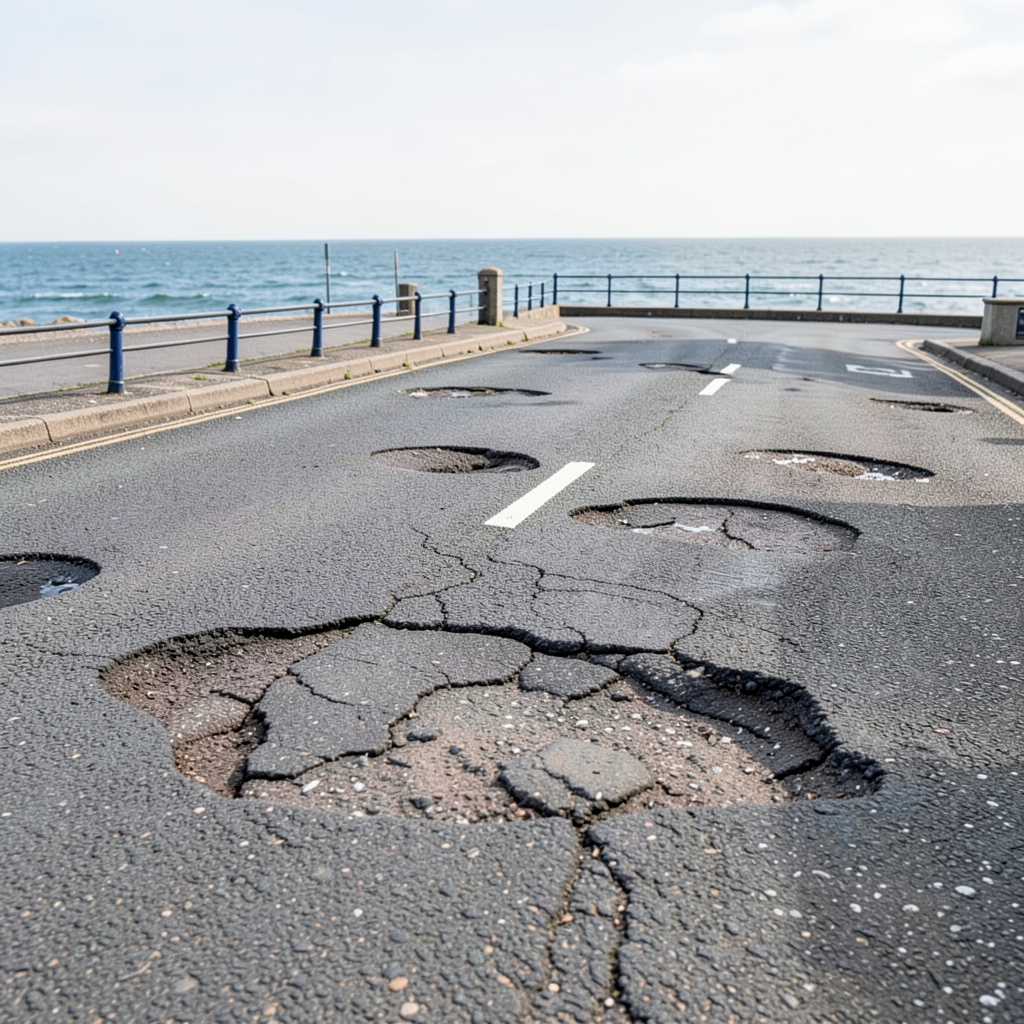

Brighton and Hove has been identified as the local authority area with the greatest proportion of main roads in the worst condition across England.
Official figures reveal that 17 per cent of the city’s main roads were classified as red, representing the poorest category, placing Brighton and Hove at the top of the national rankings.
Research published by the Department for Transport demonstrates that 45 per cent of English local authorities experienced a deterioration in their main road network between March 2024 and March 2026.
Local authorities are obligated to conduct regular assessments of road surfaces, assigning each section a classification of red to indicate poor condition, amber for fair condition, or green for good condition.
Roads marked red are considered to require maintenance consideration.
Analysis of data from 147 councils that submitted figures for both years shows that 66 authorities saw an increase in the percentage of red-classified main roads, 53 recorded no change, and 28 reported improvements.
A Department for Transport representative clarified that the published figures relate to the total length of road affected within each local authority area rather than the number of individual roads.
The data concerning A-class roads also incorporates sections of motorway that fall under local authority management.
The statistical release follows complaints from traders regarding extensive works on a section of Western Road, with the reconstruction project expected to continue for 45 days.
Investment plans for Brighton and Hove’s road network have been announced.
Earlier in 2026, Simon Lightwood, then serving as Minister for Buses and Local Transport, unveiled a national funding package of £7.3 billion to be distributed to councils over four years for road repairs and pothole remediation.
Brighton and Hove was allocated more than £26 million from this programme for road maintenance purposes.
According to the minister, more than 20 roads within the city would undergo micro-asphalt resurfacing treatments.
This technique can prolong road surfaces by as long as a decade while helping to prevent the formation of potholes.
A substantial summer resurfacing initiative was also initiated earlier in the year.
The scheme encompasses 34 roads, totalling in excess of 126,000 square metres, scheduled for resurfacing or surface treatment.
These works form part of a broader £8.8 million investment programme for 2026/27 aimed at improving both roads and pavements, with financial support provided by the Department for Transport.
The Department acknowledged that variation exists in the assessment equipment employed by different councils, which may influence how road surfaces are categorised.
This inconsistency means the criteria used to classify a road as red could vary between different local authority areas.