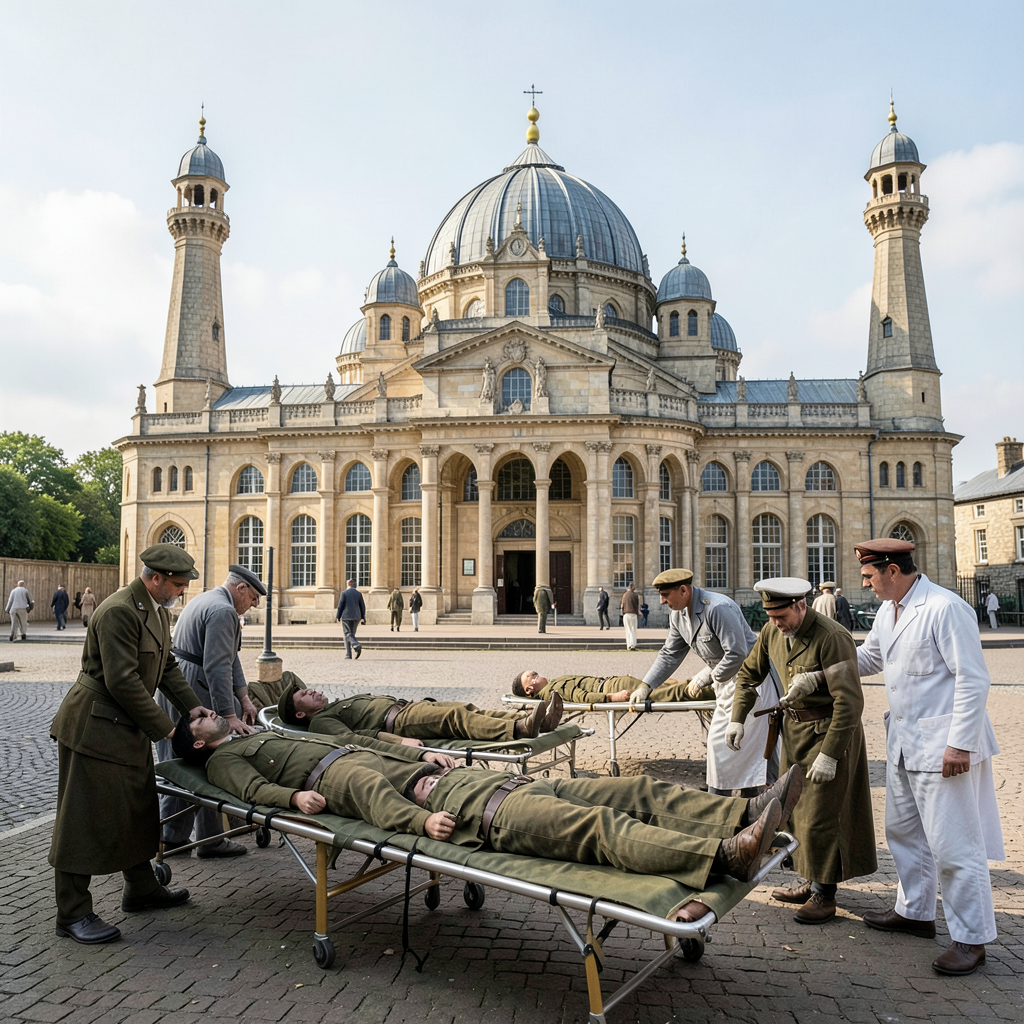

During the First World War, Brighton’s Royal Pavilion was transformed from an Indian-inspired palace into a hospital for wounded members of the Indian Army.
The distinctive architecture of its minarets and domes made the building appear familiar to many of the patients, although its peacetime role had been entirely different.
Created by George IV, the pleasure palace had never been intended to receive mass casualties.
Belgium was overrun by German forces in 1914, prompting the German army to advance towards France.
Britain’s imperial war effort drew heavily on personnel from its colonies, and soldiers from India volunteered for military service.
Thousands were sent to the Western Front to resist the German advance, with about 1,800 arriving during October 1914, the first month of their deployment.
Wounded troops were transferred from battlefield hospitals to medical facilities along Britain’s south coast, with journeys passing through Dover, Southampton and Eastbourne.
Limited capacity in conventional institutions led the authorities to requisition schools, town halls and other public buildings for additional treatment space.
George V believed the Pavilion estate could provide suitable accommodation for wounded Indian soldiers, partly because its design drew upon Indian architectural features.
His proposal was adopted, and 724 beds were installed in the Dome, the Corn Exchange and the Pavilion itself.
Pressure on the facility subsequently resulted in the opening of another 2,000 beds at the Elm Grove workhouse and 550 places in schools on Pelham Street.
The first patients arrived in December 1914.
Gunshot wounds were the principal reason for admission.
On reaching the hospital, patients were X-rayed and their wounds drained under anaesthetic so that staff could determine the extent of infection.
Dressings frequently consisted of sphagnum moss wrapped in muslin.
Some men had already undergone amputations before arriving in Britain, leaving the Pavilion to provide continued medical supervision, recovery treatment and convalescence.
Although clinical care was advanced for the period, sanitation and food provision presented considerable difficulties.
Separate taps, washing facilities and latrines were required for Hindu and Muslim patients, while nine kitchens were established to prepare meals for different caste requirements.
Animals intended for meat dishes were ritually slaughtered at a butcher’s premises in St James’s Street.
A gurdwara was also erected on the grounds for Sikh worship, and an area in front of the Dome was reserved for Muslim prayer, with the space oriented towards Mecca.
Not every patient recovered.
The remains of Hindu and Sikh soldiers who died were cremated with full ritual observances on ghats established on the Downs above Patcham.
A later account in the Brighton Herald characterised the events then unfolding in Brighton as one of the most unusual chapters in England’s wartime history.
The presence of a large Indian contingent also attracted considerable public interest.
A high wall was erected around the Pavilion, limiting visitors’ views of the hospital and its grounds.
Passengers on nearby trams could obtain the clearest sight of the patients from an upper deck for a fare of twopence.
The hospital and the care provided to its inhabitants were widely publicised, partly because Britain sought to counter German claims that Indian troops were mistreated.
Publicising the hospital also reinforced the impression that British authorities honoured the loyalty of colonial soldiers and accommodated Hindu, Muslim, Sikh and other communities.
Letters written by patients to relatives indicated that some unconscious men arrived believing they had entered heaven after seeing the Pavilion’s elaborate interiors, particularly the music room.
The correspondence also expressed strong patriotism and loyalty.
One soldier conveyed the view that dying in battle for the King was equivalent to reaching heaven.
George V visited the hospital on two occasions during 1915.
On his second visit, he presented 11 wounded soldiers with military honours.
More than 1,000 patients assembled on the western lawn for the ceremony, which was also attended by Queen Mary, Lord Kitchener and other dignitaries.
Subedar Mir Dast received the Victoria Cross for bravery at Ypres, an honour later recorded on a blue plaque attached to the wall of the present-day Pavilion shop.
Mir Dast praised the care offered by British personnel, describing the treatment given to Indian soldiers as exceptionally generous and fraternal.
He reported that British comrades had shown no distinction between British, Mahometan and Hindu troops and had treated them alike.
The award ceremony was recorded on film, and surviving black-and-white footage shows the hospital lawns filled with patients, including men who had lost limbs.
Some played games, while others were pushed in wheelchairs or received medals.
The King saluted and shook hands with people during the visit and was also shown lighting a cigarette.
The footage was subsequently used for propaganda purposes, presenting the hospital as evidence that the sons of the Empire were receiving proper care.
The Indian Army left the Western Front in late 1915 and was reassigned to the eastern Mediterranean.
From January 1916, the hospital lost the facilities established specifically for its Indian patients.
The Pavilion complex then accommodated severely injured British soldiers until 1920.
As the Indian contingent departed, the authorities responded to public curiosity by opening the Pavilion, Dome and Corn Exchange for inspection.
Admission initially cost 2s 6d, with proceeds going to the Mayor of Brighton’s War Charities.
By early February, 10,000 people had visited.
Many also purchased an official souvenir publication priced at one shilling, which ran to 120 pages and included 35 illustrations.
Two permanent memorials emerged from the hospital’s wartime role.
A southern gateway was constructed in 1921 as a gift from the princes and people of India.
Bhupinder Singh, Maharaja of Patiala, unveiled the structure in October and used a golden key to open its gates.
During the ceremony, he disclosed that 28,000 troops from his own state had fought in the war.
The gateway was designed by Thomas Tyrwhitt in the manner of 16th-century buildings in Ahmedabad, the principal city of Gujarat.
Film of the occasion shows the covering flags being removed, followed by a handshake between the Maharaja and Brighton mayor Bertram Southall before they entered.
The second memorial, known as the Chattri, was erected above the ceremonial ghats near Patcham, where 53 Indian soldiers were eventually cremated and their ashes scattered at sea.
Designed by EC Henriques, a young Hindu architect, it takes the form of a white domed structure supported on pillars and follows the style of Indian monuments to the dead.
The name means umbrella.
The Chattri was unveiled in February 1921 by Edward, Prince of Wales, who later became Edward VIII.
Its inscription commemorates the Indian soldiers who died in the service of their King-Emperor and dedicates the monument to those who died in the Brighton hospital and passed through the fire at the cremation site.
Across the Royal Pavilion estate, 2,300 patients received treatment during the Great War.
The wider Indian military contribution involved an estimated 1.4 million people, including personnel in non-combatant roles, while military troops suffered more than 74,000 casualties.