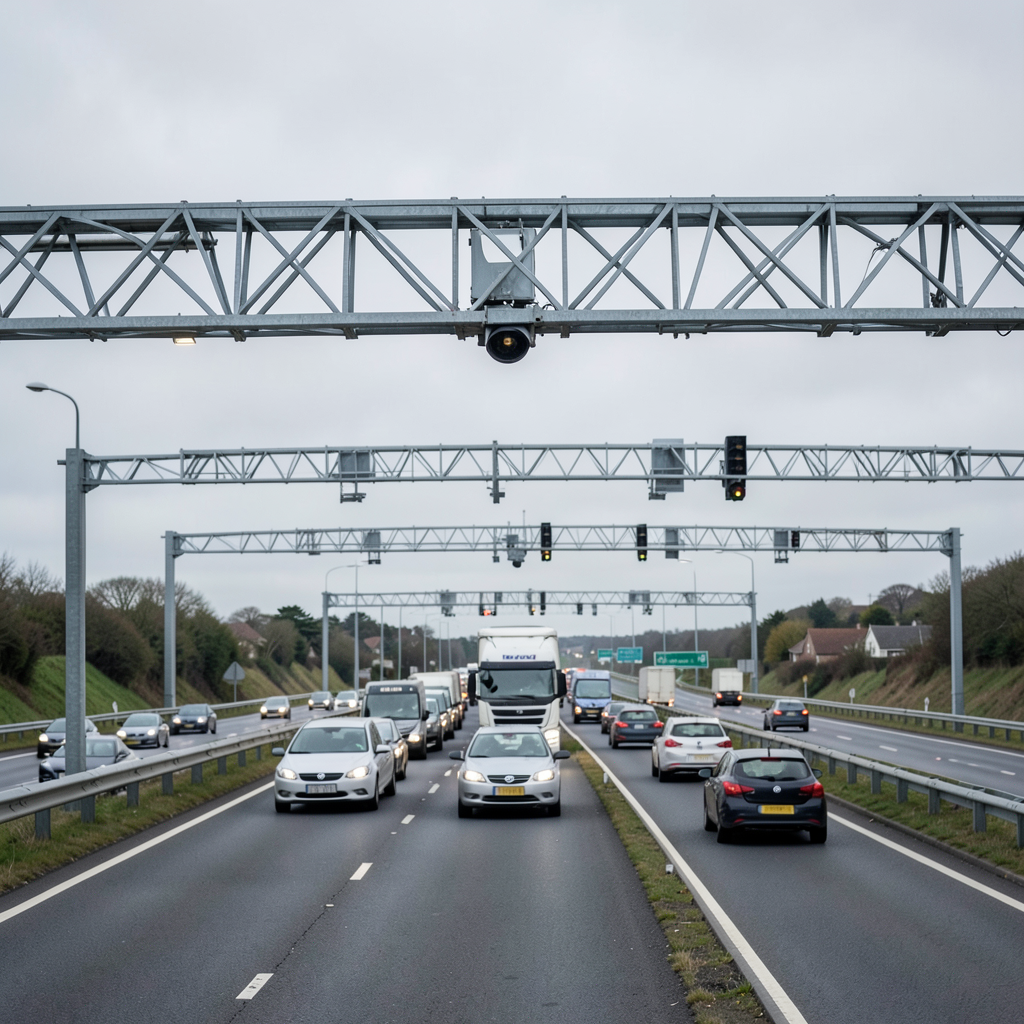

Drivers traversing Sussex’s roads have been alerted to a widespread misunderstanding regarding speed enforcement on smart motorways that could result in significant financial penalties.
Transportation safety specialists have identified a common false belief among road users that automated enforcement cameras on intelligent motorway sections only function during specific operating windows.
This inaccurate assumption may expose motorists to substantial fines, penalty points on their licences, and potential driving bans.
A vehicle industry professional has emphasised the importance of drivers understanding that monitoring equipment on these roads remains operational continuously, cautioning against relying on incorrect information.
Representatives from Select Car Leasing have noted that numerous motorists persist in believing surveillance cameras on smart motorways do not operate continuously throughout the day and night.
This belief is incorrect.
Gantry-mounted enforcement devices can record vehicles travelling above 70mph even when no adjustable speed restriction is currently displayed on overhead signage.
Industry experts have indicated that many road users assume speed monitoring equipment only functions when electronic signs above the carriageway indicate a temporary reduced limit such as 50mph or 60mph.
These drivers understand the requirement to reduce speed upon seeing such warnings but mistakenly conclude that during standard conditions they cannot be penalised for exceeding the national limit, provided no police officers are visibly present.
This assumption is fundamentally inaccurate.
Various online discussion platforms contain numerous accounts from motorists who have received penalties under these exact circumstances.
Enforcement consequences for exceeding speed restrictions on motorways can be considerable, in addition to the obvious safety hazards and potential risk to life.
The M23 carriageway incorporates a smart motorway segment within Sussex territory.
Smart motorways have become a significant element of Britain’s strategic road network, providing additional capacity and more efficient traffic management.
However, these adaptable routes also present distinct safety challenges requiring driver awareness.
These roads employ dynamic speed restrictions to regulate traffic movement and improve safety standards, with limits changing based on congestion levels, incident occurrences, or maintenance operations.
Within Sussex, a smart motorway portion exists on the M23, spanning from Junction 8 at the M25 interchange through to Junction 10 serving Crawley and the A264 road.
The southern section of this infrastructure improvement extends into West Sussex in the vicinity of Crawley, covering a distance of approximately 11.3 miles.
The emergency shoulder has been transformed into a permanent running lane, expanding the carriageway to four lanes throughout this section, while adjustable speed limits have been implemented.
Planned maintenance operations will necessitate road closures along the M23 corridor this coming week.
From Tuesday through Thursday, overnight carriageway and lane restrictions will be in effect to facilitate gantry repair works on the southbound carriageway between Junctions 7 and 8, operating between 10pm and 5.30am each night.
On Friday, lane and link road closures will be implemented for similar gantry maintenance on the M23 southbound route between Junction 8 and the M25 junction, together with a link road closure at Junction 7.
No scheduled closures are planned for the weekend period.
Speed detection devices operate through radar technology or sensor systems embedded in the road surface to monitor vehicle velocities and document any violations.
While earlier models relied on photographic film, contemporary equipment employs fully digital recording systems capable of calculating average speeds across extended distances.
These electronic systems capture multiple pieces of information including the speed at which the vehicle was travelling, the precise time and location of any alleged offence, the vehicle’s registration details, and the applicable speed restriction for that road section.
In certain instances, these devices can also produce clear images showing both the driver and any passengers within the vehicle.
A widespread misunderstanding exists regarding the circumstances under which enforcement action may be triggered.
Specialist motoring analysts have clarified that no standardised tolerance margin equivalent to ten percent plus two miles per hour is formally incorporated into legislation.
Industry sources have stated that the notion that a driver is protected when travelling at 35mph in a 30mph zone represents one of the most prevalent misconceptions encountered.
Technically, liability for a monetary penalty commences immediately upon exceeding the posted limit by any amount.
While the National Police Chiefs’ Council does advocate a ten percent plus two mile per hour guideline to provide officers with discretion, this recommendation does not constitute a statutory threshold and may vary according to the specific location or individual officer responsible for reviewing the case.
Road safety organisations have advised that legislation specifies that drivers become liable for speeding penalties immediately upon surpassing the applicable limit.
Consequently, travelling at 31mph within a 30mph zone or 71mph on a motorway constitutes an offence potentially attracting financial penalties.
The determination of whether to issue a penalty ultimately rests with the individual officer who detects the violation.
The most prudent approach remains adhering strictly to posted speed restrictions at all times.