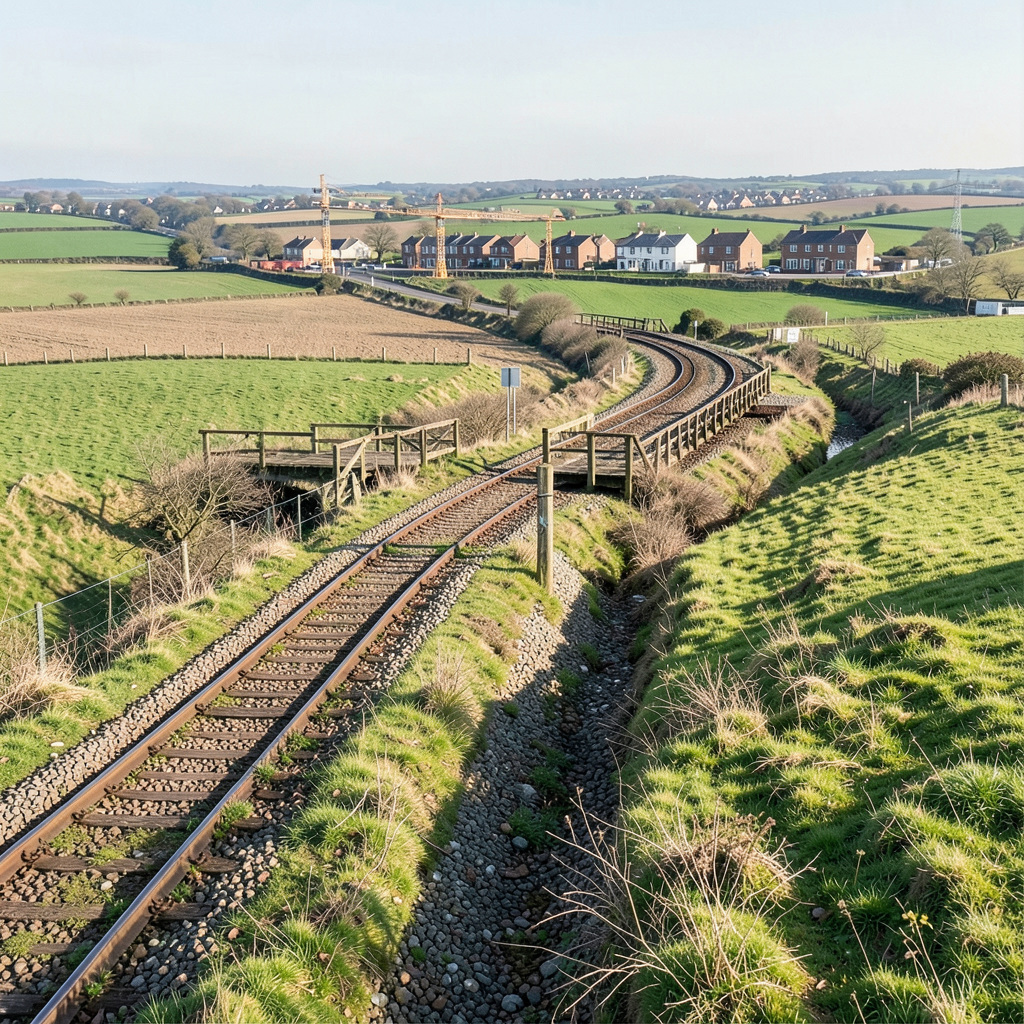

Concerns that a proposed development of 1,700 residences could obstruct efforts to restore a decommissioned railway corridor in Sussex have sparked demands for protective measures to be implemented.
East Sussex County Council endorsed a proposal on October 13 put forward by Conservative councillor Michael Lunn, which urged the authority to restate its commitment to reviving the defunct line connecting Uckfield and Lewes.
The proposal arose from apprehension regarding both a substantial residential scheme earmarked for the Owlsbury Farm location in Uckfield and plans for the Lewes to Uckfield Greenway, a prospective pedestrian and cycling pathway linking the two communities.
Without adequate safeguards embedded within the development, space essential for accommodating twin railway tracks, a prospective station, and a suitable intersection with the A22 highway could be permanently lost, according to Cllr Lunn.
The current Greenway concept has been devised under the premise that any eventual railway restoration would involve only a single track.
Cllr Lunn emphasised that this premise represents an assumption rather than an established policy position and should not serve as a permanent limitation on a corridor of strategic transport significance.
The proposal specifically requested that the authority correspond with Wealden District Council, urging the district to confirm that its determination regarding the Owlsbury site and its broader local plan framework would not compromise any future railway reinstatement.
Additionally, the motion called upon the district council and its collaborative partners, including Lewes District Council, to provide assurance that Greenway proposals would not jeopardise the potential restoration of the railway.
A briefing prepared by county council officers highlighted that both the Wealden and Lewes local development frameworks already contain provisions designed to safeguard the potential reinstatement of the route.
The briefing further observed that a Greenway constructed along the historic railway alignment would not inherently preclude subsequent railway restoration, though it could amplify the practical, financial, and political obstacles connected with any future reopening.
Despite securing approval through a majority vote, the motion did not receive endorsement from the council’s Green and Liberal Democrat groupings, both of which chose to refrain from voting.
Representatives from both political groups contended that the proposal was superfluous.
Kelvin Williams, who serves on Wealden District Council’s executive, characterised the motion as politically performative rather than substantive, asserting that both district councils at Wealden and Lewes already endorse reopening the line and protecting its corridor.
He indicated support for the concept of railway restoration while questioning the rationale for introducing such a motion at this particular juncture.
Johnny Denis, a member of Lewes District Council’s cabinet, similarly dismissed the proposal as immaterial, noting that protective mechanisms already exist within adopted and emerging local plans, as well as within the county council’s own strategic documentation.
He stated that the objective of restoring the railway line represents a universally shared aspiration and serves a genuine necessity.
Peter Griffiths of Reform UK, who holds the county council’s transport and environment portfolio, offered an alternative perspective, expressing support for a cycling and walking route to Lewes provided it does not utilise the historic railway formation.
He stressed the imperative of preserving the railway formation, acknowledging that multiple bodies have expressed future intentions but without specifying timescales, and expressed the view that reinforcing the commitment to maintaining the corridor for a prospective twin-track railway would prove beneficial.