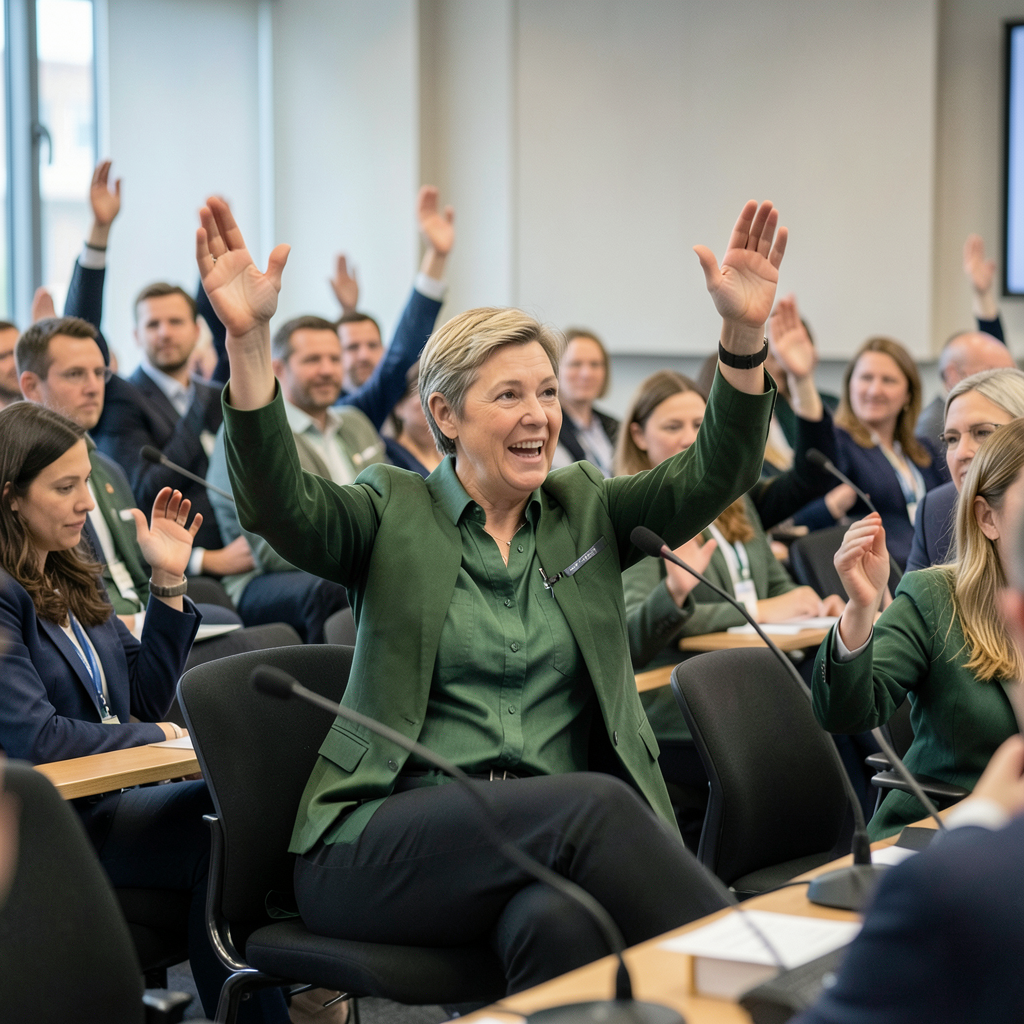

The Green Party’s adoption of a policy describing Zionism as racism has prompted sharply divided responses from Green councillors across Sussex, despite several local groups publicly condemning antisemitism.
Delegates at the party conference in Brighton approved the policy on October 4 by 1,022 votes to 813.
The measure has since prompted national debate and faced criticism from Jewish organisations, Labour politicians and some party members.
Among its provisions, the policy characterises Zionism as an ethnonationalist political project.
It advocates one democratic state spanning historic Palestine, backs the Boycott, Divestment and Sanctions movement, calls for a complete arms embargo against Israel and affirms Palestinian refugees’ right to return.
Opponents contend that establishing such a state would entail the disappearance of Israel.
They also say Zionism can carry different meanings for different individuals and does not automatically amount to approval of Israeli conduct towards Palestinians.
A proposed third amendment would have protected Jewish party members attending synagogues that identify as Zionist.
That change was rejected by 1,026 votes to 684.
The Argus sought details of the conference votes from Green councillors across Sussex.
Every councillor who provided a response said they had opposed the policy, although the strength and nature of their objections varied.
One councillor nevertheless appears to have given public backing to it.
All 12 Green councillors representing Brighton and Hove signed a joint statement condemning antisemitism, expressing support for Jewish residents and rejecting any equation of anti-Zionism with antisemitism.
The statement did not say whether those councillors backed the policy itself.
Hastings Green councillors issued a comparable collective statement without identifying their position on Motion A105, the Zionism is racism policy.
Paul Brown, a Mid Sussex Green councillor, supported Amendments 1, 2 and 3 while voting against the main policy.
Lewes councillor Charlotte Keenan also rejected it, saying she fundamentally disagreed with the policy and the conference’s decision to adopt it.
The wider Lewes District Green group likewise declared its opposition in correspondence with Labour colleagues.
Green councillor Sarah Sharp, representing Chichester South, said the proposal failed to reflect the values associated with the Green Party.
She particularly cited tolerance, respect, care and concern for people as principles incompatible with the measure.
East Sussex county councillor Karen Simnett did not attend the conference.
She said she would not have supported the text but endorsed its underlying aim, citing the displacement and ethnic cleansing of Palestinians, an apartheid system and an ongoing genocide as inherently racist.
Hastings councillor Yunis Smith was reported to have joined an open letter with 60 other Green councillors from across the UK.
The signatories maintained that the policy had been portrayed in ways they did not recognise and said their backing reflected a commitment to equal rights, opposing racism and resisting oppression in every form.
Smith did not respond to requests from The Argus to clarify his position.
The dispute has emerged against a wider rise in antisemitism and Islamophobia across Sussex and elsewhere in the UK following the Hamas attack on Israel on October 7, 2023.
Figures highlighted by The Argus showed that antisemitic hate crimes in 2025 reached three times the previous year’s total of 41.
During the same period, the number of Islamophobic hate offences rose by 60 per cent from a prior-year figure of 68.