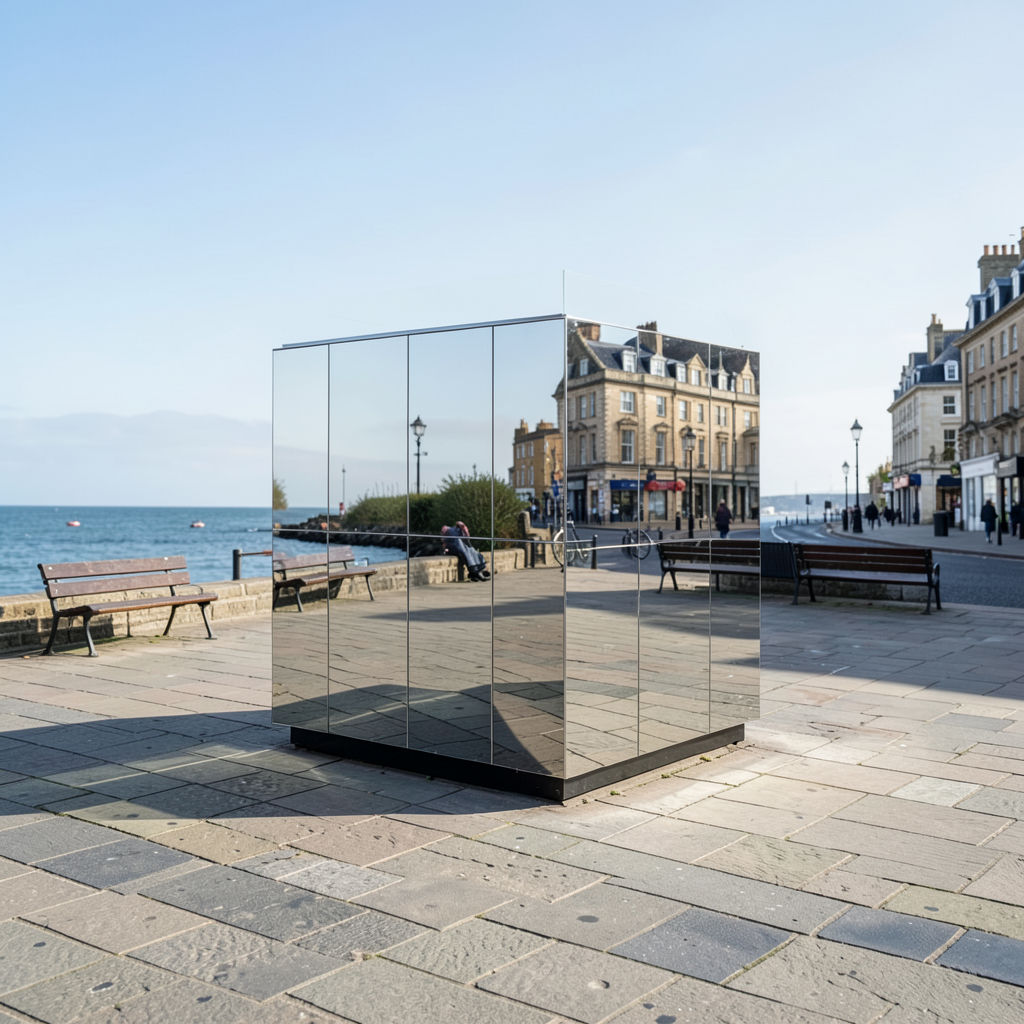

A national initiative is using artistic intervention to highlight the invisibility of individuals whose chronic health conditions prevent participation in everyday public life.
The project amplifies the experiences of people living with Myalgic Encephalomyelitis and Long Covid by bringing their testimonies to locations they cannot visit in person.
The touring exhibition launched at the Royal Opera House in London during mid-September.
Brighton’s Jubilee Square subsequently hosted the installation for two days in October.
The structure comprises a chamber constructed from two-way mirrored acrylic panels.
When visitors enter the enclosed space, their reflection disappears from the surrounding view.
Inside, audio recordings play for visitors—recordings submitted by individuals who selected that particular venue as a place they would occupy if their health permitted.
Visitors are subsequently encouraged to compose and dispatch a postcard in reply, establishing a dialogue between individuals absent due to illness and those present in shared spaces.
As the exhibition progresses through different communities, these recordings, written responses and interactions gather into an evolving collective artwork.
Arts Council England provides funding through a National Lottery Project Grant.
Invisible Visible CIC, a community interest company, manages the initiative.
Composer Dr Amble Ysgawen-Skuse, who has experienced the installation, described it as a poignant and emotionally resonant piece that establishes a gathering point for difficult conversations about the marginalisation of people with Myalgic Encephalomyelitis from broader society.
Future tour dates include Thornton Heath Leisure Centre in Croydon during November.
The installation then moves to the Tate Modern in London for two days in March 2027.
Subsequent venues encompass Whitby in North Yorkshire, Robin Hood’s Bay and Bingley Five Rise Locks in West Yorkshire.