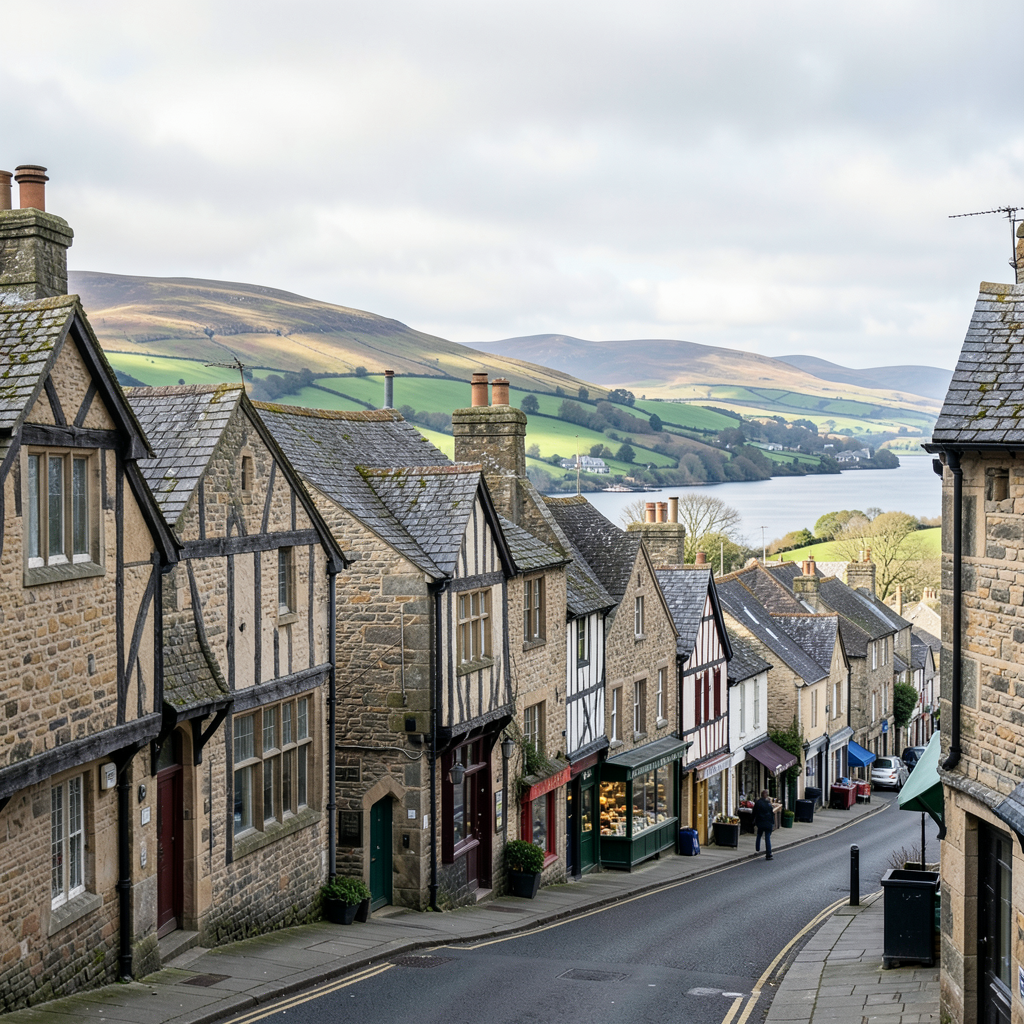

This West Sussex market town boasts medieval origins and a rich heritage that continues to define its character today.
Positioned at the northern entrance to the River Adur valley within the South Downs, the settlement lies roughly four miles inland from the coast near Shoreham-by-Sea and falls under the jurisdiction of Horsham.
The community forms part of a larger urban expanse together with the adjacent settlements of Bramber and Upper Beeding, representing an important crossing point over the waterway.
Historical accounts trace the settlement’s foundations to Saint Cuthman, with the original place of worship reportedly established before the ninth century.
The early community developed around this religious site, with Church Street traditionally regarded as the community’s oldest street.
The original timber church was superseded during the twelfth century by the Norman structure of Saint Andrew’s Church, which continues to stand.
Given the proximity of a harbour facility, the settlement functioned as an important trading port shipping various merchandise.
By the year 858, the settlement had come under the protection of the Wessex royal family, with King Ethelwulf interred within its grounds.
The settlement remained crown property until the eleventh century, when Edward the Confessor bestowed it upon the French monastic foundation at Fécamp after the Norman conquest.
Medieval records documented 123 households and approximately 1,500 inhabitants, ranking it among the most substantial settlements in the southeastern region during that period.
However, the fourteenth century brought considerable difficulties.
The gradual silting of the waterway, the emergence of an alternative harbour at Shoreham, and the catastrophic plague of 1348 all contributed to a significant downturn.
By 1350, the settlement had ceased functioning as a port, and subsequent suppression of the local priory under Henry IV caused further hardship.
Recovery commenced during the following century, with numerous period structures still present throughout the area.
Contemporary visitors discover a thriving centre distinguished by independent retail establishments, a regular producers’ market, and complimentary parking facilities.
The culinary scene offers diverse dining options alongside accommodation choices.
The surrounding landscape attracts hiking enthusiasts, being accessible to the South Downs Way and additional long-distance trails.
Local points of interest encompass Chanctonbury Ring, Cissbury Ring, and the picturesque valley.
A longstanding bookseller operating from historic premises on the main commercial thoroughfare has served the community for over four decades, maintaining an especially respected children’s department.
The establishment occupies a building dating to the eighteenth century.
One notable hostelry, approaching six centuries in existence, previously operated as a judicial venue and assembly hall, today retaining an antique billiards table for customer use.
The community numbers distinguished figures among its past and current residents.
A musician who spent her formative years locally advanced her recording career after securing a contract with a major label in 2018 and subsequently joining another prominent artist-owned imprint in 2021.
Her initial full-length collection appeared shortly thereafter, while a second album released in 2023 claimed the top position on the national music chart.
A third collection emerged in spring 2026.
A celebrated writer, recognized primarily for a work featuring a fictional monster, also originates from this locality.
The author, who initially composed melodies for children’s programming before transitioning to literature with a debut picture book in 1993, attained the distinction of becoming the nation’s highest-selling author in early 2025.
Among the writer’s extensive catalogue of nearly two hundred titles, approximately sixty-four remain in general retail circulation, with the remainder designed for educational purposes.