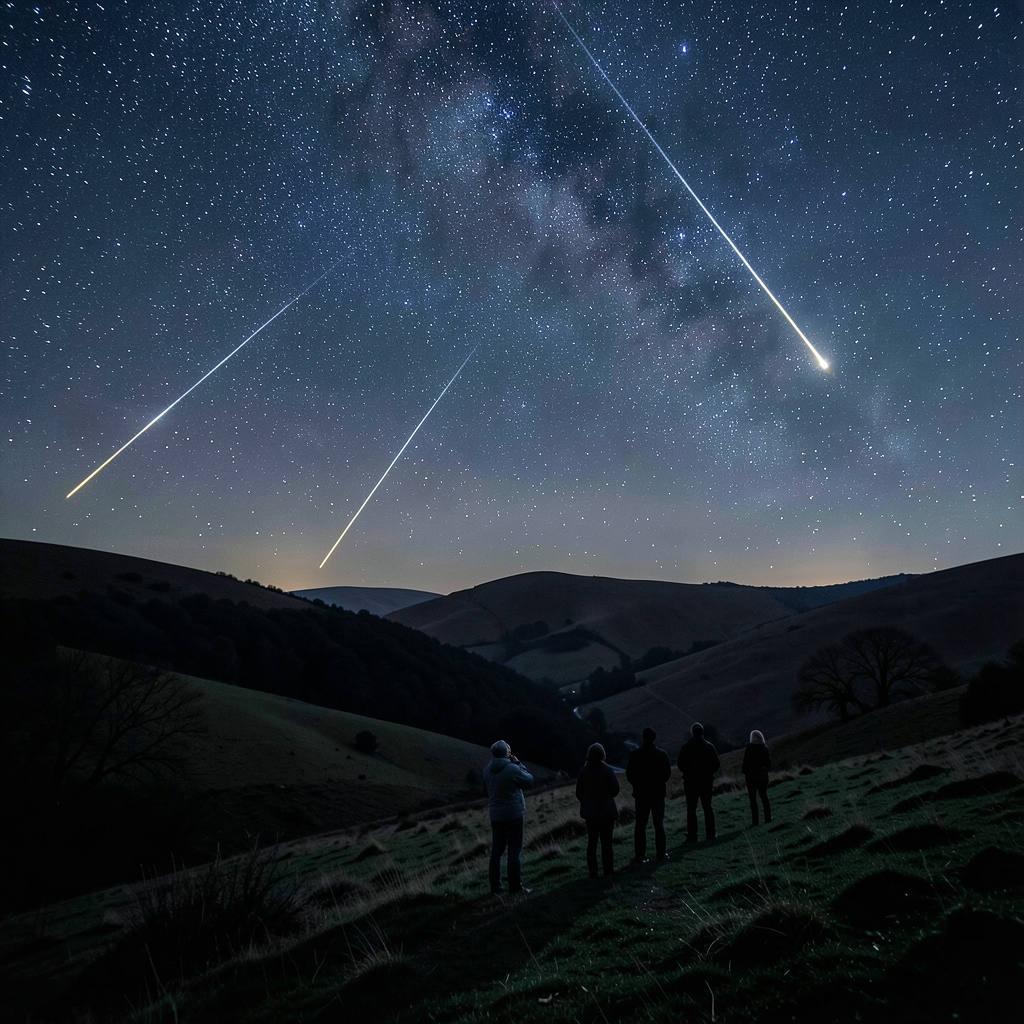

The Draconid meteor shower will be visible across UK skies this week, with Sussex offering particularly favourable conditions for observation.
The county contains some of the darkest skies in the south-east of England, making it an excellent destination for watching the celestial event.
The South Downs National Park provides multiple locations suitable for spotting the brief luminous streaks as they traverse the night sky.
From elevated vantage points such as Ditchling Beacon to coastal areas like Birling Gap, several sites offer the dark, unobstructed conditions necessary for meteor watching.
The shower will be observable between October 6 and October 10, with the most intense activity anticipated on October 9.
Unlike numerous other meteor displays that require observation during the small hours, the Draconids reach their best visibility in the evening, making them accessible to watchers of all ages.
The phenomenon occurs when Earth travels through fragments shed by comet 21P/Giacobini-Zinner, according to information from Royal Museums Greenwich.
The quantity of meteors visible during peak activity varies depending on which section of the comet’s debris trail the planet’s orbit crosses in any particular year.
Favourable conditions are expected this time, as the peak aligns with dark skies and a slender crescent moon appearing just before sunrise.
Specialists advise selecting an area free from artificial light, with an unobstructed view of the horizon and no direct illumination sources.
Optical aids such as binoculars or telescopes are unnecessary, as the meteors are most easily observed with unaided vision.
Within Sussex, the South Downs National Park stands as an International Dark Sky Reserve and hosts several Dark Sky Discovery Sites.
Ditchling Beacon in East Sussex ranks among the county’s highest elevations, granting sweeping perspectives across the Downs and holding Dark Sky Discovery Site status.
Birling Gap and the Seven Sisters coast provide unimpeded southern views across the sea, combined with minimal artificial light interference.
This National Trust location also holds Dark Sky Discovery Site designation.
Bignor Hill in West Sussex frequently appears among the darkest localities in the area.
On clear nights without moonlight, the Milky Way band can occasionally be distinguished from this position.
Firle Beacon, situated near Lewes, delivers strong sightlines and represents another reliable venue for astronomical observation.
Observers should refrain from looking at bright light sources to permit their eyes to adjust properly to darkness.
With several optimal sites available and conditions appearing favourable, Sussex is well-positioned to witness this year’s display.
Warm attire, a blanket, and some endurance represent everything required to appreciate the event fully.