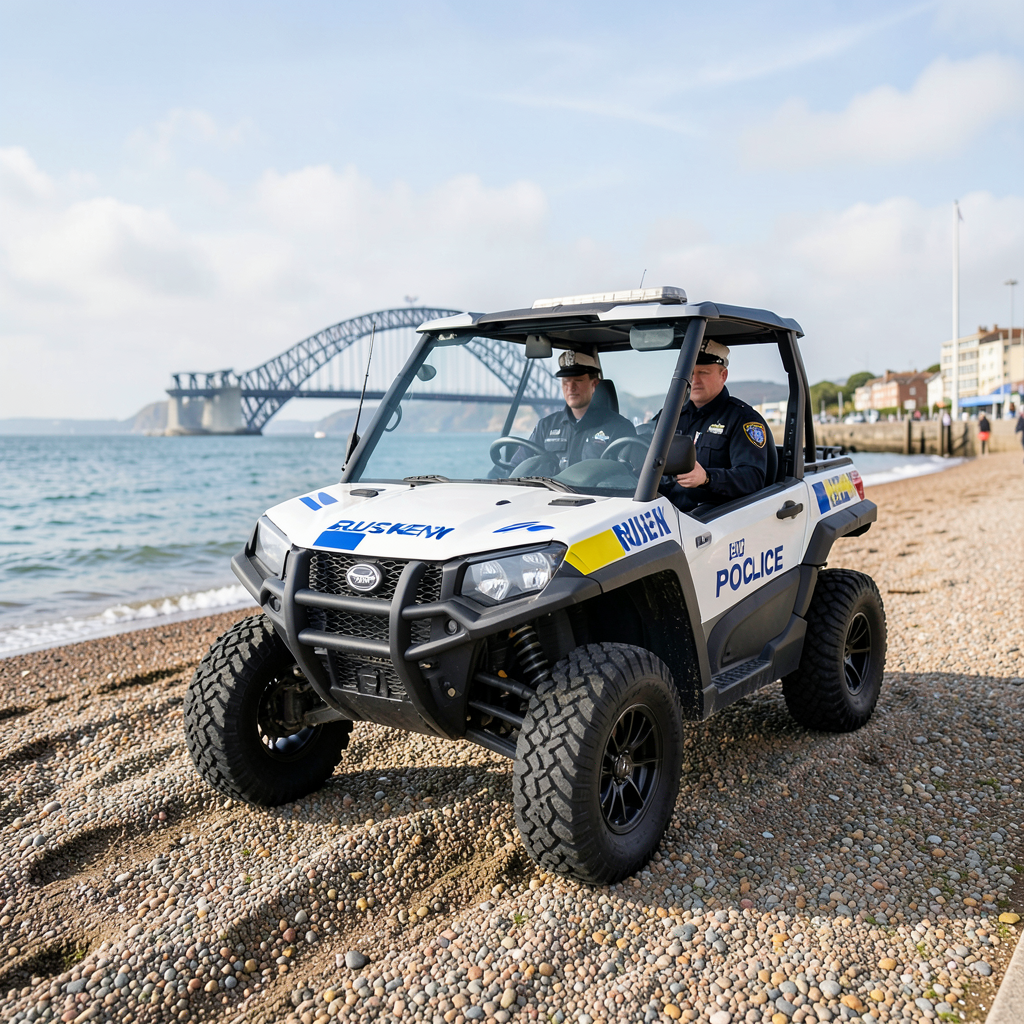

Sussex Police has acquired an all-terrain vehicle for deployment along Brighton’s seafront, enabling officers to respond more rapidly to incidents, enhance water safety measures and address violence directed at women and girls.
The vehicle represents the first ATV to join Sussex Police’s operational fleet and has been specifically designed to traverse both roads and sandy surfaces, facilitating the coverage of extensive coastal areas without delay.
Chief Inspector Dan Hiles explained that the addition would work alongside current policing methods rather than substituting established approaches.
The all-terrain vehicle has been introduced as a supplementary resource to enhance the force’s existing arrangements for protecting people within the night-time economy.
It provides a valuable additional capability to support the work already being conducted.
Existing operational methods employed by the force include the utilisation of aerial drones, officers on foot patrols and intelligence gathered through the Business Crime Reduction Partnership, which assists in identifying individuals who may be vulnerable and detecting potential criminal activity.
Mr Hiles noted that the vehicle provides officers with another operational option for patrolling the heavily frequented seafront areas.
The ATV has not been engineered for rapid acceleration or high velocities.
Its power unit has been configured to deliver torque rather than speed, meaning observers should not anticipate officers travelling at speed along the beach.
The vehicle’s design prioritises reliable progress across sand while preventing entrapment.
The vehicle features accommodation for two occupants in the front compartment and provides rear storage capacity for equipment required during water rescue operations.
Mr Hiles indicated that conversations were progressing with the RNLI and additional partner organisations regarding the carriage of potentially life-saving equipment such as defibrillators and throw lines.
Multiple serious incidents have occurred along the coastline in preceding months, including several fatalities in the sea during the summer period.
Three women lost their lives in the water at Black Rock, while a family comprising four members died after encountering difficulties in the sea at Shoreham.
Mr Hiles expressed his intention to develop considerably closer working relationships with the RNLI and to formulate joint plans that would guarantee the provision of optimal safety support for all individuals requiring assistance with water safety matters.
However, water safety constitutes merely one aspect of the ATV’s intended purposes.
The vehicle has also been designed to contribute to efforts tackling violence against women and girls and to accelerate the force’s responses when reports concerning vulnerable individuals are received.
A significant element of the vehicle’s role has been formulated to target violence against women and girls during evening hours.
The capacity to respond swiftly when concerns are communicated by partner organisations regarding individuals who appear vulnerable or are behaving suspiciously represents a priority for the force.
The ATV has been equipped with powerful illumination systems, including an elevated rotating beam that officers can utilise to survey beach areas and the promenade.
A number of police forces throughout the United Kingdom have already incorporated ATVs into their vehicle fleets.
Other forces across the country have deployed all-terrain vehicles as part of their operational resources, though this represents the inaugural example of its kind operating within Sussex.
The force intends to monitor its performance and assess its effectiveness.
Mr Hiles reported that initial deployments had already enabled officers to reach members of the public more swiftly than would otherwise have been achievable.
He expressed confidence that the vehicle was already making a meaningful difference, with officers having successfully intervened in situations involving members of the public where timely response would not have been possible without the ATV.
The vehicle has also attracted considerable public attention, with members of the public frequently approaching officers to inquire about it.
Beyond its role in maintaining public safety and disrupting potential criminal activity, the ATV serves as an effective engagement mechanism, as members of the public demonstrate interest in discussing the vehicle with officers.