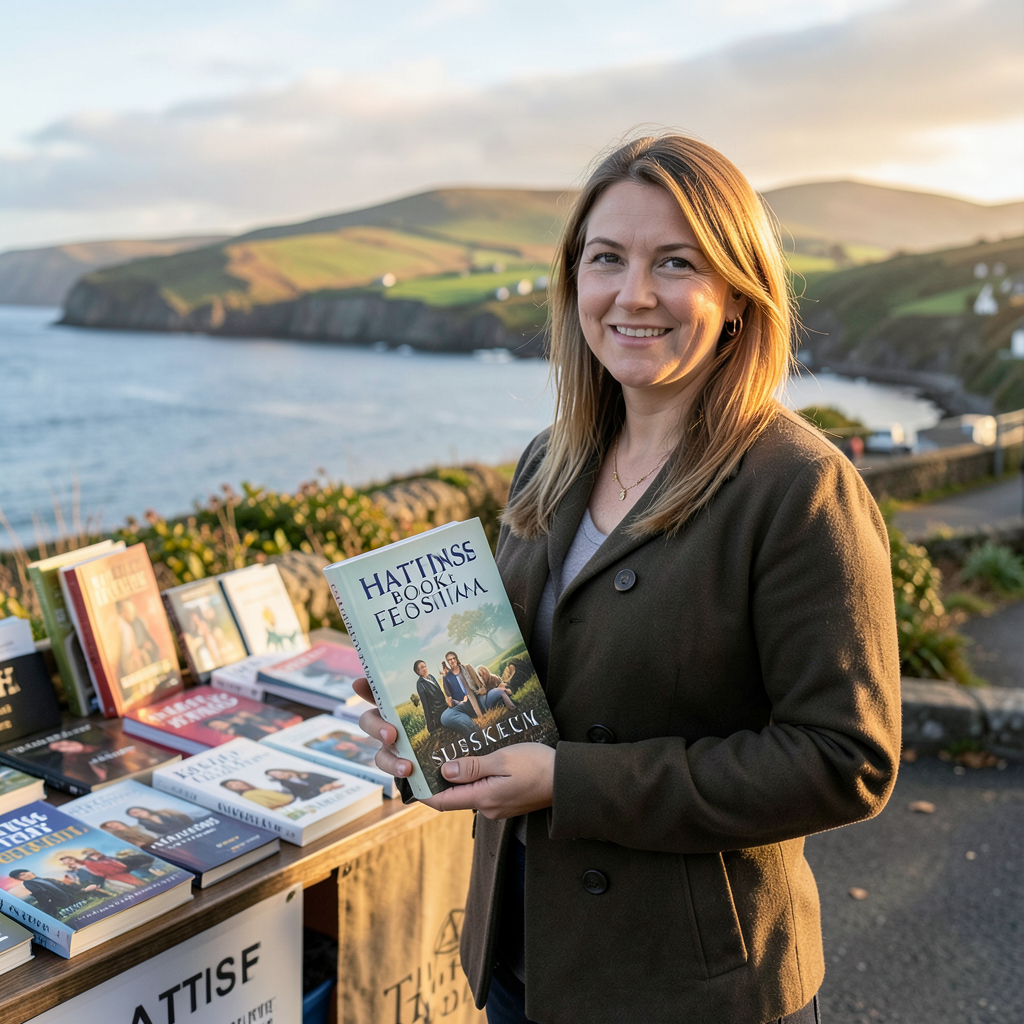

The bestselling novelist Kate Mosse has spoken of her deep attachment to Sussex ahead of a scheduled appearance at Hastings Book Festival.
The author, who spent her formative years in Fishbourne and currently resides in Chichester, explained that the county’s landscapes, history and folklore have exerted a profound influence throughout her literary career.
During an interview conducted before her festival appearance, Mosse addressed several topics including her involvement with the Women’s Prize Discoveries programme and the forthcoming historical thriller Borderlands.
She has presided over the judging panel since the initiative was established six years ago and expressed pride in witnessing its continued expansion.
The programme has attracted more than 16,000 entrants seeking to support unpublished women novelists, with particular emphasis on those from under-represented and working-class backgrounds.
Mosse reflected that fiction fundamentally concerns the creation of imagined worlds through individual creativity and imaginative endeavour.
She emphasised that successful writing requires an ineffable quality beyond mere documentation of existing reality, and noted that the programme consistently identifies writers demonstrating this ambition to produce distinctive work.
The initiative aims to distinguish between potential and opportunity, recognising talented individuals who may lack formal training or industry connections.
According to Mosse, insufficient self-assurance remains one of the most significant obstacles confronting women writers.
She observed that as someone who has advocated for gender equality for many years, it remains troubling that confidence issues persist among female authors.
She noted that young women frequently dismiss their own creative efforts, undervaluing their work.
Additional barriers include caregiving duties, restricted availability and economic constraints, leading the programme to increasingly prioritise providing guidance and assistance through digital platforms.
Alongside her advocacy work, Mosse is currently promoting her latest publication Autumn, which she characterises as an amalgamation of memoir, folklore, nature writing, music and verse.
The work examines concepts of home, belonging and recollection, with a central premise encouraging readers to discover solace and strength in the natural environment during challenging periods.
Maintaining optimism represents a meaningful stance, she suggested.
For readers familiar with Sussex, Autumn incorporates numerous locations significant to the author’s personal experience.
These include Kingley Vale, which Mosse regards as containing Europe’s most ancient yew forest, along with Chanctonbury Ring, Devil’s Dyke, Lewes and the Bishop’s Palace Garden in Chichester.
The publication also explores folklore as a form of cultural memory belonging to ordinary people and their relationship with a particular region.
Mosse articulated that geographical setting forms the foundation of all her literary projects, with characters, concepts, narratives, historical context and mythology developing subsequently.
This emphasis on place also anchors her forthcoming novel Borderlands, which unfolds across contemporary Sussex and the eleventh century during the circumstances preceding the Norman Conquest.
The narrative examines sites including Bosham, Pevensey, Battle and Hastings, using Sussex as a lens through which to understand broader concepts of English identity.
The story employs the time-slip technique that brought Labyrinth to prominence more than two decades ago.
Mosse had long sought to address the Norman Conquest and its enduring effects on concepts of identity and belonging.
The theme carries personal significance, as genealogical evidence indicates her family has maintained connections to Sussex since 1066.
A William de Mosse, apparently a member of William the Conqueror’s forces, emigrated from a small settlement called Moss in Normandy, survived the invasion and established himself in Sussex.
The novel examines questions of lineage, loyalty and national identity through a narrative spanning Sussex and Normandy.
Mosse, who has resided in Sussex for fifty of her sixty-five years, explained that she now values the connections she once found restricting.
During her youth she resented feeling so firmly tied to a particular location, though with advancing years she has recognised that while she could relocate anywhere globally, nowhere else would feel like home.
When asked what distinguishes Sussex, she indicated that the county inspired the central philosophy of Autumn.
She described the book as her tribute to Sussex while maintaining that the publication’s broader purpose encourages readers to contemplate their own relationships with the places that have shaped them.