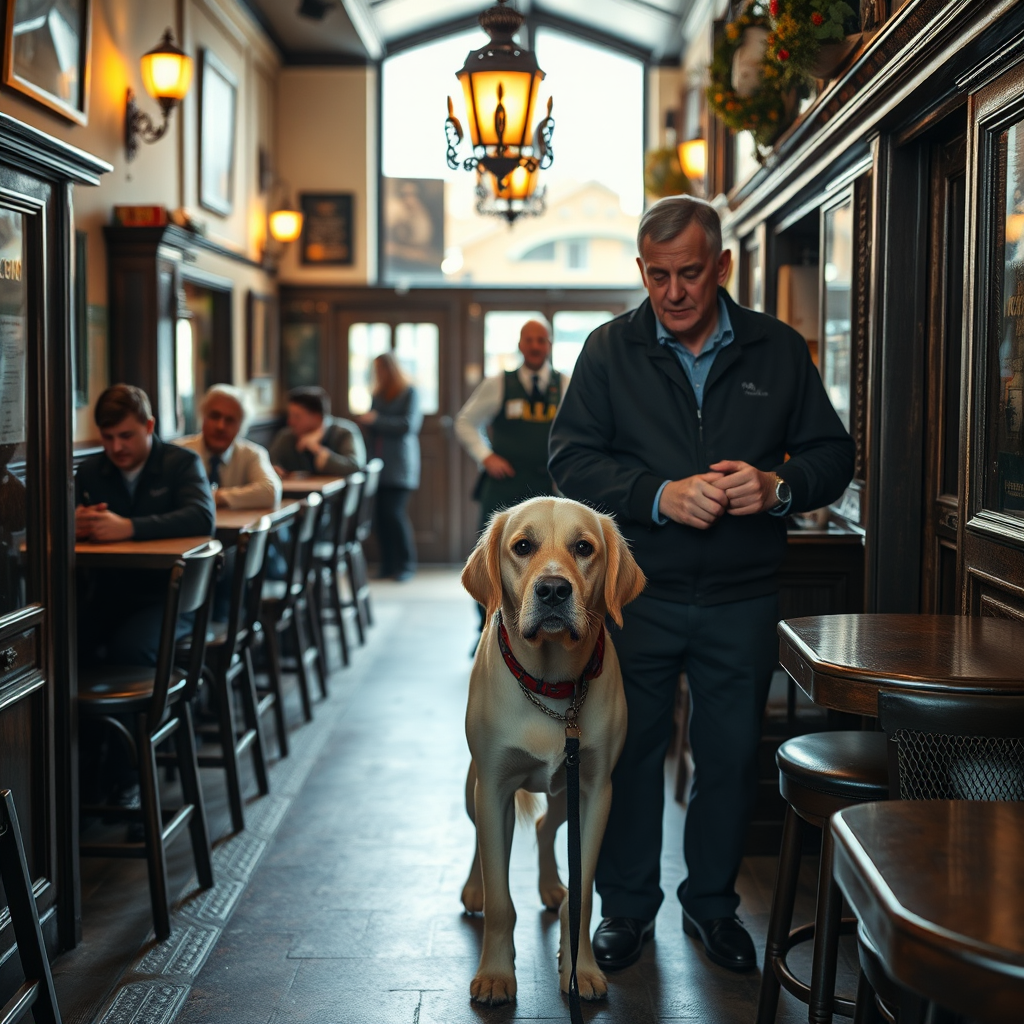

A man who is partially sighted said he was asked to leave Wetherspoon by staff because of his guide dog.
Tariq Ahmad went to The Bright Helm in West Street, Brighton, with his family to celebrate his sister’s 40th birthday on March 20.
The 38-year-old was accompanied by his guide dog, Trine, and the family ordered drinks.
Mr Ahmed said that while greeting his parents he was approached by two members of staff and was asked to show an Assistance Dogs UK ID.
They added that if he could not show them this licence, he would need to leave, he said.
Mr Ahmad and his family subsequently left the pub.
He said the incident was “discriminatory” and “unlawful” under equality legislation, and he intends to take legal action.
Tariq Ahmad and Trine (Image: The Argus)
Wetherspoon has apologised for the incident.
Trine had a guide dog harness and Mr Ahmad, who is registered severely impaired, believes it was clear that he is partially sighted.
“I said I would understand if I didn’t have the harness or it didn’t say guide dog on it but it does,” he said.
Mr Ahmad spoke to one of the members of staff and asked why they “couldn’t make a reasonable adjustment”, to which he was told it is “company policy”, he said.
“They kept saying it’s company policy, it doesn’t matter,” Mr Ahmad said.
“I said it’s the law. Company policy does not subside the law.”
He went on to show staff his guide dog contract, but was told it was not enough, he said.
He said: “I thought ‘this is ridiculous, we’re not required to carry that’. It’s unlawful.”
Mr Ahmad said everyone was “quite upset” and the incident caused him a significant amount of distress.
Wetherspoon said it “welcomes customers with guide dogs and assistance dogs with accredited training from Assistance Dogs UK member organisations or that have been certified by the Assistance Dog Assessment Association”.
A spokesman for the Equality and Human Rights Commission said it is “aware that a significant number of disabled people with assistance dogs have been refused entry from JD Wetherspoon venues” and it has written to the business.
‘Our beautiful boy’ – Family pay tribute to Sussex police officer killed in collision
‘Our beautiful boy’ – Family pay tribute to Sussex police officer killed in collision
Tributes paid after devoted Brighton supporter dies in the line of duty
Tributes paid after devoted Brighton supporter dies in the line of duty
Beloved pet put down after being savaged by dogs in ‘terrifying’ bus attack
Beloved pet put down after being savaged by dogs in ‘terrifying’ bus attack
It added that under the Equality Act 2010, “assistance dogs don’t need to be registered and people with assistance dogs don’t need to carry proof of their disability to enter a venue”.
“Businesses and service providers have a duty to make reasonable adjustments for disabled people – including those with assistance dogs – so they are not put at a disadvantage,” the spokesman said.
“We have written to JD Wetherspoon to ensure they are aware of their duties under the law. As Britain’s equality regulator, we will keep watch on whether JD Wetherspoon takes steps to ensure their policies and practices comply with the Equality Act 2010 and stand ready to review this position if necessary.”
Mr Ahmad said discrimination is becoming more frequent, having experienced four incidents in the last week.
“Because of the amount of discrimination in Brighton and Hove, I have now made a decision that she will probably be my last guide dog,” he said.
The Bright Helm in West Street, Brighton (Image: Google)
“Something really needs to change. There is so much hate.
“When it affects you so much you have to fight.”
In 2022, Mr Ahmad told The Argus about how he was “refused an Uber ride” and believed it was because he had a guide dog.
A spokeswoman for Assistance Dogs UK, a coalition of assistance dog charities, said it was “very sad to hear of this case” and it was “far from isolated”.
She added: “Under the Equality Act 2010, disabled people are not required to carry identification or documentation for their assistance dog. This is not ADUK’s opinion; it reflects statutory guidance, and this is the guidance we encourage organisations to follow.
“ADUK believes that we urgently need clearer definitions in law of assistance dogs, alongside consistent standards for training and welfare that all working assistance dogs can aim to meet – whether trained by ADUK members or otherwise.
“We continue to advocate for this clarity and consistency in order to ensure that disabled people are able to access public places with their trained assistance dogs.”
A spokesman for Wetherspoon said: “Wetherspoon welcomes customers with guide dogs and also assistance dogs with accredited training from Assistance Dogs UK member organisations or that have been certified by the Assistance Dog Assessment Association.
“We apologise to the customer who was asked to leave the premises.
“If he would like to contact our customer services team, we will address his concerns directly.”
Clive Wood, lead regional policy and campaigns manager at charity Guide Dogs, said: “The guidance from the Equality and Human Rights Commission is clear: ‘Assistance dog users should not be refused a service simply because they do not have an ID book.’
“While there are understandable checks needed for travel abroad, we expect everyday shops and businesses to take a common-sense approach.
“Guide dogs, like other types of assistance dogs, enable people to live independently, and disabled people should not be forced to justify their presence every time they use a business or service.”
Daniel Brookbank, CEO of East Sussex Vision Support, said: “I am very disappointed that in 2026 vision impaired people are still experiencing this kind of basic discrimination from a large organisation that should know better.
“A guide dog is quite clear to anyone and Wetherspoon should enable its staff to make sensible decisions that do not force them to discriminate.