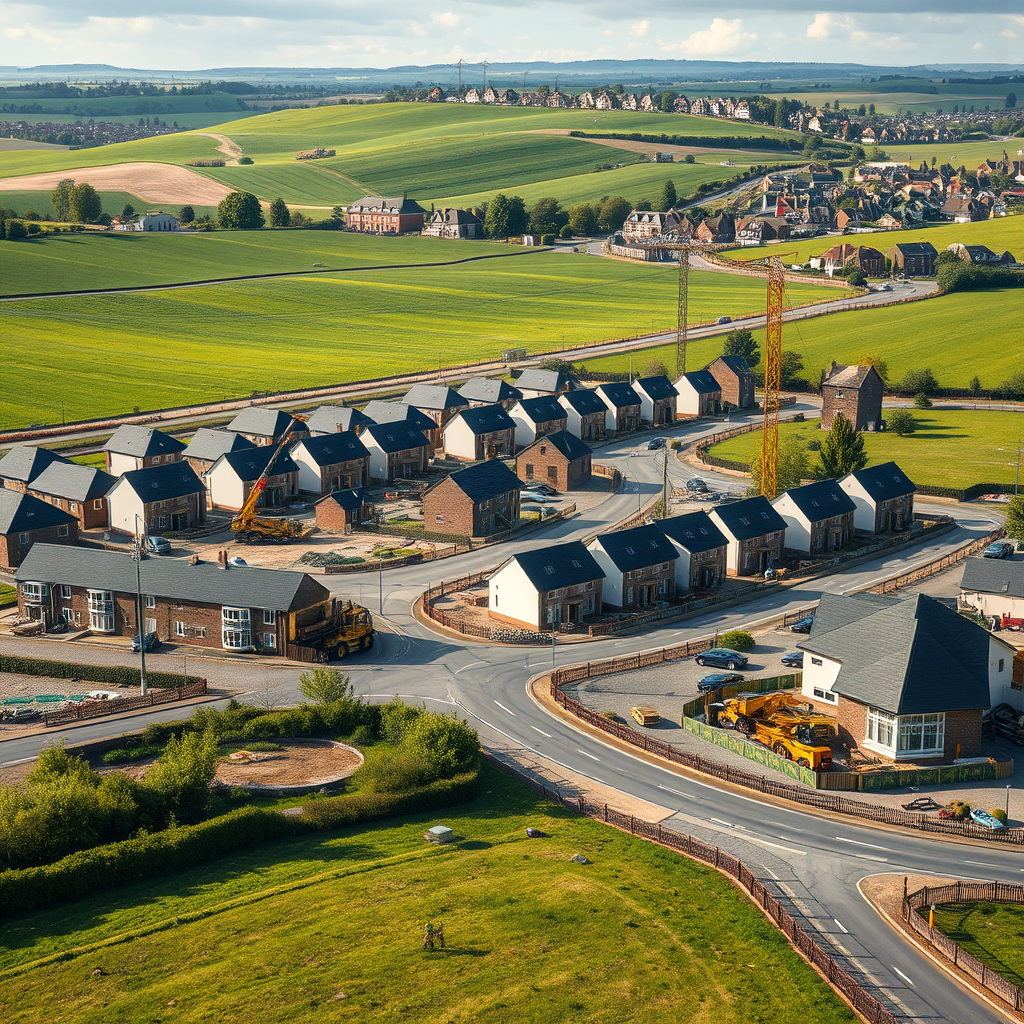

A fresh proposal for a new market town in the Sussex countryside has emerged.
Rownsmoss Wessex Limited has approached Lewes District Council to gather feedback regarding the environmental implications of constructing as many as 3,000 residential units to the east of Plumpton Green, prior to filing a formal development application.
The council received this inquiry on April 2, with official validation occurring on Tuesday (April 14).
An objective environmental assessment prepared by Stantec and funded by Rownsmoss accompanied this submission, detailing the proposed development concept.
According to the document, the project would comprise between 2,600 and 3,000 dwellings, with 40% designated as affordable housing and accommodation specifically for senior residents.
The view northwards from the path east of Plumpton Green
The proposal also encompasses a primary school offering two to four forms of entry, alongside nursery facilities and special educational needs provisions as necessary, plus a new commercial district serving as the development’s central focal point.
A neighborhood center and athletic pavilion would also be developed, along with improved connections to Plumpton Green, its rail station, and South Chailey through transportation infrastructure and bus services.
The development aims to preserve roughly 60% of natural terrain, encompassing restoration of historic woodland, creation of recreational areas within the Bevern Valley, and interconnected green pathways.
Additionally, the plans include an energy facility, renewable energy infrastructure, and a 20% improvement in biodiversity, along with ecological approaches to water management and flood prevention.
The full planning submission is anticipated in December 2026, according to the document.
The subsequent phase involves Lewes District Council formally agreeing to assess the environmental implications of the proposal on April 22.
Comparable proposals have surfaced previously, encountering opposition from activists.
In 2021, the Don’t Urbanise The Downs initiative was established in response to earlier plans for a 3,000-home development on land owned by Eton College.
During that prior controversy, the Ouse and Adur River Trust cautioned that contaminated runoff entering the Bevern Stream could endanger one of Britain’s most significant populations of sea trout spawning grounds.
North Barnes Farm, the proposed construction area, had been previously identified in Argus reporting as property belonging to Eton College.
The development would commence with 500 residences and progress through five distinct stages to ultimately accommodate between 2,600 and 3,000 homes.
Essential infrastructure, including the new primary school, would be established during the initial phase and enlarged during the fourth phase, with green spaces incorporated throughout all stages.
The Stantec assessment indicates construction activities would commence in 2029 and conclude by 2039.