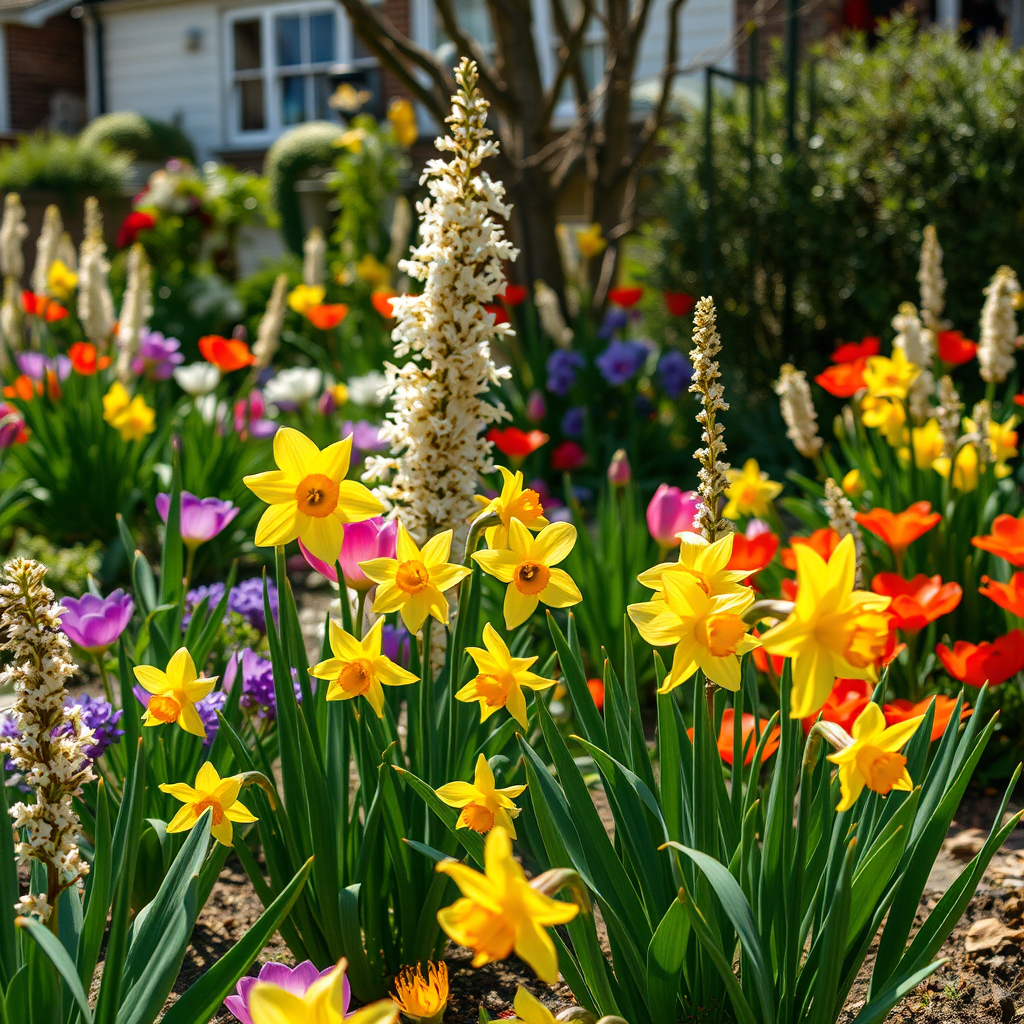

Spring has truly brought the garden to life.
The white bottle brush remains the sole plant still covered with fleece, visible over my shoulder in the accompanying photo. I’m removing it this week in anticipation of opening my garden to visitors.
Several beautiful flowers have been looking particularly impressive lately, especially the Narcissus ‘Actaea’, a classic daffodil variety. The blooms differ significantly from typical daffodils, featuring large white outer petals surrounding a small yellow cup bordered with orange. They emit a pleasant fragrance and reportedly remain largely untouched by deer, making them suitable for wild meadow areas. They work wonderfully at the front of a spring border or in containers as part of a seasonal display. Mine are planted in a bed near the house that will soon be filled with new fern fronds.
I have a number of camellias growing against the north-facing wall at the back of the house. One I bought last autumn called April rose has produced a single small but perfectly formed flower this spring, shown in the picture below. Camellias do not tolerate lime and thrive in neutral or acidic soil (pH 7 or below) that is rich in humus, moist, and well-draining. For this reason, all of mine are planted in large containers. They prefer a partially shaded location with a westerly or sheltered northerly exposure. It is crucial to avoid south or east-facing positions as the early morning sun following frosty nights can damage the flowers. They also cannot withstand exposed windy locations or soil that becomes waterlogged during rainy periods. Light dappled shade from trees and other shrubs works well, provided the roots have adequate moisture.
This weekend sees two gardens opening for the National Garden Scheme across both days (18 and 19). The first is Limekiln Farm in Chalvington Road, Chalvington, near Hailsham, open from 2pm to 5pm with admission of £8. The garden was designed in the 1930s when Charles Stewart Taylor, MP for Eastbourne, owned the property. Its fundamental layout has remained unchanged since that time. The planting scheme aims to reflect the age of the C17 house and original garden design. The house and garden appear in Virginia Woolf’s diaries from 1929, capturing a particular charm and tranquility that persists today. Flint walls enclose the main lawn, herbaceous borders, rose garden and courtyard lined with nepeta. There is an informal pond and specimen trees, including a very ancient oak. Many spring flowers and tree blossom are in evidence. The new prairie-style garden featuring grasses and perennials can also be viewed.
The second property is The Oast in Fletching Street, Mayfield, open from 11am to 5pm with entry £6. This one-acre garden enjoys an idyllic High Weald location with beautiful views. Over 4000 tulips and other spring bulbs are in bloom, and visitors can wander through a half-acre wildflower meadow containing older roses and an orchard. There is a woodland-edge walk, wildlife pond, and vegetable and soft fruit areas. Quality homegrown plants are available for purchase. Full details on both gardens can be found at www.ngs.org.uk.
I have some particularly attractive cyclamen growing close to the house. This hardy perennial produces delicate dark green leaves with silver markings and dainty blooms in white, pink and red shades from late winter through early spring. They thrive at the base of small shrubs and trees and can naturalise in grass. They reach heights of 10cm, with rounded dark green leaves that may feature silver marbling on the upper surface. The flowers measure approximately 2cm across and often display a purple blotch at the base of each petal, opening from late winter onward. They grow best in humus-rich soil in partial shade and should be mulched annually with well-rotted leaf mould to prevent the tubers from drying out in summer or suffering from winter cold.
Meanwhile, the striking clivia in the back porch is looking particularly fine. This showy, frost-tender houseplant creates a bold feature in the home or conservatory. It produces sturdy stems bearing large, rounded clusters of colourful flowers from late winter through spring. The foliage is architectural and attractive throughout the year, comprising wide, dark green, strap-shaped evergreen leaves growing from a swollen, fleshy root. Each flowerhead consists of eight to ten bell-shaped blooms, typically in shades of orange, though yellow and red varieties occasionally become available. Clivia is also known as the forest lily, since in its native South Africa it grows in woodland areas. Mine was a gift to my mother from her lifelong friend Edna Bradbury, who passed away a couple of years ago.