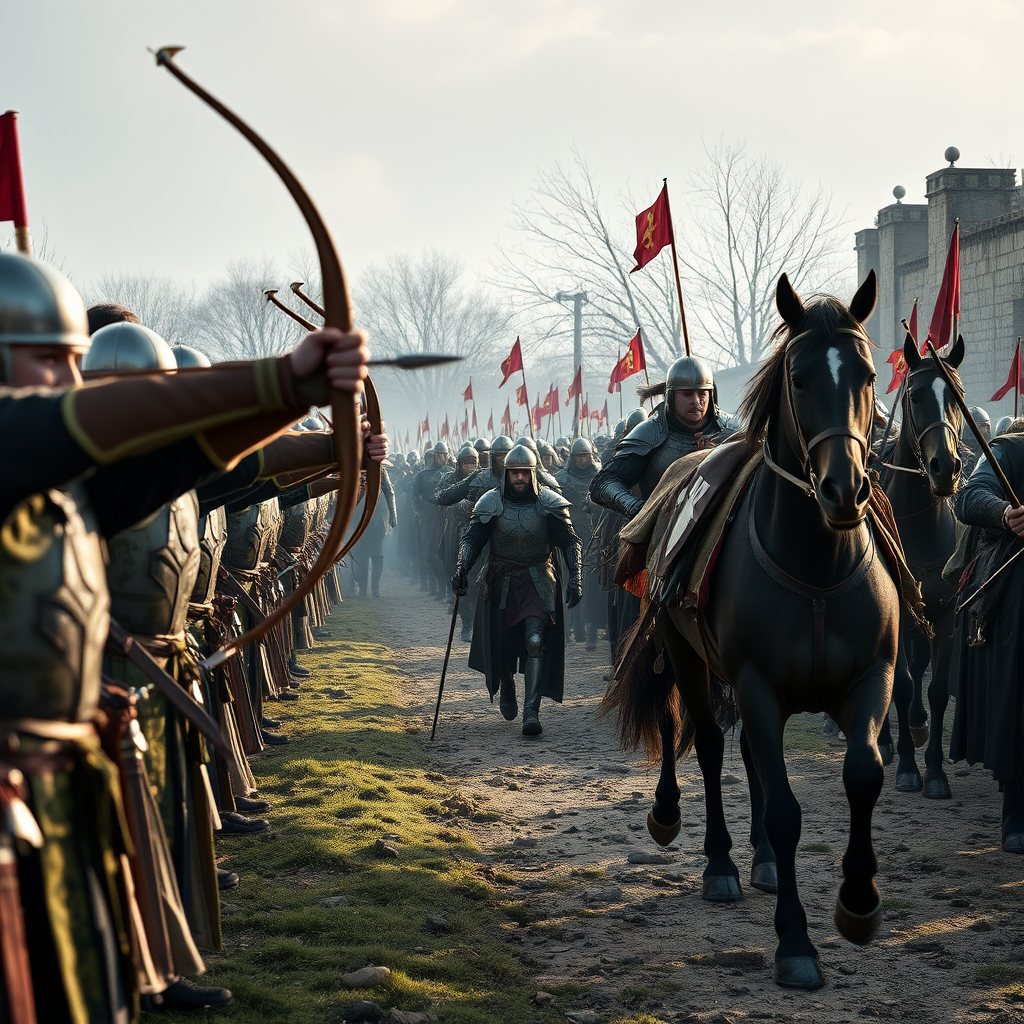

It’s a crisp, cold afternoon. Horses’ hooves stamp impatiently and archers await their cue amongst the hundreds of warriors that will clash as they bring the Battle of Hastings to life in the very place that warriors fought in 1066 – writes Karen Pasquali Jones for our sister publication Sussex Life.
As I walk towards the historic site, at Battle Abbey, I step back in time to the scene of England’s most famous battle. Smoke gently rises from the encampments, its pungent smell filling the air. Falcons stand to attention, surveying the scene and there’s an air of anticipation.
When Nigel Amos rides on to the historic battlefield at The Battle of Hasting Re-enactment, he will no longer be a stay-at-home dad and amateur historian but Duke William who will become King William I – better known as William The Conqueror as he brings to live the conflict that led to his victory against King Harold and his claim to the English throne.
The 59-year-old has been a reenactor for over 30 years. What started as a hobby, quickly turned into a lifelong passion, particularly when he began riding. ‘I didn’t get on a horse until I was 30 and then it was to be a Norman knight,’ he laughs. ‘I started as a Saxon originally and now here I am finally at the pinnacle of my career coming on the field as William.’
Reenactors research the people they portray, ensuring that the clothes they wear and equipment used is as authentic as possible. It has fuelled Nigel’s interest in the subject – leading to a degree in medieval history and appearing on screen with the Norman cavalry troop The Conroi, most recently for the Dan Snow BBC 2 series 1066: A Year to Conquer England.
Nigel feels that reenactment has a huge amount to offer about the way people lived and can teach us about history in a way that books can’t. ‘This period is a lot more complex and layered than our schoolboy history teaches us,’ he says. ‘There are so many practical aspects to reenactment such as cooking over a fire – you learn pragmatic skills, that aren’t taught anymore, nowadays we just chuck things in the air fryer.
‘From a spectacle point of view, we will have 21 horses in the reenactment – imagine what it would have been like in reality with 1,000? Being in a group of horses working together, you can really imagine the energy of the battle.’
Playing William has given Nigel an understanding of the man but he has to be careful not to get too carried away with the character. ‘If you adopt too much of the persona when you’re riding a horse or waving steel weapons around, someone’s going to get hurt,’ he says.
Who decides who is going to die? ‘Most of the battles fought for this period are open-ended and it’s an imperative fight, but in this case obviously the Normans have to win and the Saxons will all die. One thing I can guarantee is it won’t be me!’
Although most people would imagine this is a hobby for the few, there’s a cast of hundreds over the two days at the re-enactment, organised by English Heritage, with crowds of more than 11,000 people coming to watch.
‘It’s an amazing community, people I know include paramedics, a nuclear physicist, teachers and firemen, all coming together with a common interest,’ says Nigel. It’s more than just battles but living history and there’s so much scope for people to be involved.’
With so many warriors, weapons and horses on the battlefield some movements have to be choreographed. ‘We can’t have the horses charging up the field, while archers are retreating, so we have to be strict about choreography,’ Nigel explains. ‘We have to make sure enthusiastic people who died violently haven’t died right in the way of where we’re about to charge through.’
Although swords and spears are understandably blunt, reenactors are trained in their use. Nigel will carry a lance when on horseback but it’s for show. ‘In the cavalry we don’t really make contact for obvious reasons. Although the original main job of the Norman horsemen was to be a mounted missile platform. It’s quite difficult to shoot an arrow from a horse unless you don’t hold the reins! If you look at the Bayeux Tapestry it shows them with lances.
Authenticity has to be balanced with safety, which Nigel admits it can be difficult. ‘You wouldn’t want to be hit over the head even with a blunt metal sword,’ he explains. ‘The irony is we have had very few injuries whereas friends involved in live role-playing that use rubber swords have had more injuries because they think their weapons are safe.’
Planning is done months in advance and societies come from all over the country and further afield including Spain, France and Germany for this special weekend.
As I weave my way through the tented mini town, people are preparing food and practising their 11th century skills. It’s fascinating to see – and smell – what’s cooking and take in the essence of the time. Story tellers enthral with ancient tales, an archer explains his skill to a crowd and a man whittling a spoon captures my attention; Cormac Stanton, an electromechanical engineer tells me it will probably take him an hour.
I watch a woman busy needle binding, a skill which preceded knitting, beautiful oak panels are being carved for a box and families feast together on simple stews, cheeses and bread, chatting and laughing. Arran Crump, a solicitor in the modern world, is cooking a hearty stew over a fire. ‘I love being able to get away from phones and speak to people,’ he says.
As well as the camps there’s an array of stalls offering historical souvenirs and battle paraphernalia, food including game burgers, as well as a good old British brew.
Imogen Allen is playing this year’s Edith Swan Neck (Edith the Fair), King Harold’s common-law wife. ‘I really love the history aspect and explaining about the intricacies of life during this period,’ she explains. ‘This history really impacts us now.’
She has been a reenactor for the past 13 years and is here with her family; her son Ethan went to his first show aged two.
Like Imogen, Edith was a mother – she had six children. When I meet the 34-year-old she is already holding court as Edith, immersing herself in the role. ‘It’s really important for me to research the historical character I am playing – what was her life like, who was she? I find her fascinating, she was wealthy in her own right and one of the richest women in England at the time. Her father was Thorkell the Tall – one of Cnut’s men.’
Imogen is a tutor from Nottingham specialising in teaching children with ADHD and autism and working with young offenders. ‘They are fascinated when I tell them what I have been doing at the weekend because they have never had that opportunity to experience history in a different way.’
Imogen first discovered history aged seven, saying to her mother, ‘When I grow up, I am going to marry a Viking.’ Just under 20 years later she had an honour guard at her wedding, complete with Viking swords, ‘I said to my mum, “I told you I’d marry a Viking!”’
The camps are a slice of life in 1066. ‘We are living authentically to this time period,’ she says. ‘There are clergy, peasants, noblemen and families. We have people repairing chainmail, people doing woodwork, making clay pots … life doesn’t stop just because two people are having a fight.’
Who decides which person plays each character? ‘Well for William and Harold you need to be able to ride a horse, it’s very bad if William falls off – the whole battle would change. For Edith, it goes to a committee, but you need to have that presence of being able to talk confidently, having the right clothes … and being able to walk across a field and cry. There’s a lot of wailing for Edith.’
Imogen has hand-made her costume; it’s simple but beautiful with a deep sleeved woollen overdress, arm rings and a cross made by historic jeweller Danegeld. Her husband Ben is playing a Saxon lord, one of the King’s guards (a huscarl). ‘He is protecting my weekend husband,’ laughs Imogen.
So what happened to Edith after the battle? ‘We don’t really know’ Imogen says. ‘We know that she lived another 20 years – they were together for 20 years, but Harold married another woman when taking the crown. There’s a picture in the Bayeaux tapestry of a woman and child which we think is Edith; she was a powerhouse in her own right.’
The tapestry will return to the UK this year, for the first time in over 900 years and Imogen is planning to see it. ‘It was all made by women, here in England. The skill, the effort and the time, it just blows my mind. Its story is still important now nearly 1,000 years on.
This is Imogen’s 13th re-enactment. ‘Thirteen years later, I am still learning things. I have no interest in being on the battlefield, but I love being able to talk about life. We sleep, eat and live here – it’s my life for the weekend.’
It’s almost time for the re-enactment to begin. Unlike a real battle we are given a live commentary, both entertaining and enlightening. The storytelling builds up the atmosphere as the crowd awaits and the Saxon army can be heard in the distance. Lances stamp on the ground and the Saxon’s beat their shields in unison; music adds to the effect, but there’s also theatrics with boos from the crowd.
A horn sounds and tonnes of horse and metal appear with over 300 people recreating the legendary battle. When the Norman army descends with William riding a beautiful white horse I presume in real life those that didn’t want to fight scarpered quickly.
Unlike the Normans, the Saxons did not have a cavalry, fighting on the ground whereas the Normans had trained horses for battle. However, a cavalry charge towards a shield wall with line of spears must have been an intimidating and terrifying sight.
Arrows launch high in the air with gasps from the audience, insults are thrown, the sound of metal-on-metal ringing in our ears. Slingshots are catapulted into the opposing army as they march towards the Saxons. The shield wall stands fast to cheers. A five year-old boy watches the action holding a wooden shield and sword. It’s hard not to be swept up in the excitement of the cheering armies.
In 1066 battle blows would have been to the knees, lower arms, face and neck. How protected you were depended on your status; metal helmets and chain mail were a Saxon luxury only money could buy or worn by the huscarls, selected for their strength. A Norman knight with chain mail, helmet and horse would have cost the equivalent of thousands to kit out.
The battle commences. Do I see a smile from one of the Saxons as he faces his Norman counterpart? People begin to stagger and fall on the field, Carrion crows cry as William’s horse rears to a cheering crowd.
It is over in under an hour, but the real blood-curdling combat of the Battle of Hastings lasted all day. William the Conqueror emerged victorious and changed the course of English history forever.
The commentator adds ‘Let the dead arise’ and the mortally wounded get up to live another day. ‘Come back tomorrow,’ he adds, ‘Who knows things may be different tomorrow.’
It’s a wonderful mix of folklore and fantasy and for those reluctant to open a history book, a unique way of learning about the period. I feel the heavy weight of a sword and watch centuries old tools being used just as our ancestors did.
Holding history in your hand is one of the great appeals of reenactment. ‘Spend time walking around the tent villages and see the difference between the two camps,’ Nigel recommends. ‘Drink in the sights, sounds and smells of the 11th century. The battle is really something to see but so is the everyday life of the ordinary people at that time.’
english-heritage.org.uk
The Bayeux Tapestry will come to the British Museum from September 2026 to July 2027. This special exhibition marks the first time the 70-metre-long embroidery depicting the Norman conquest has returned to the UK since it was made more than 900 years ago.